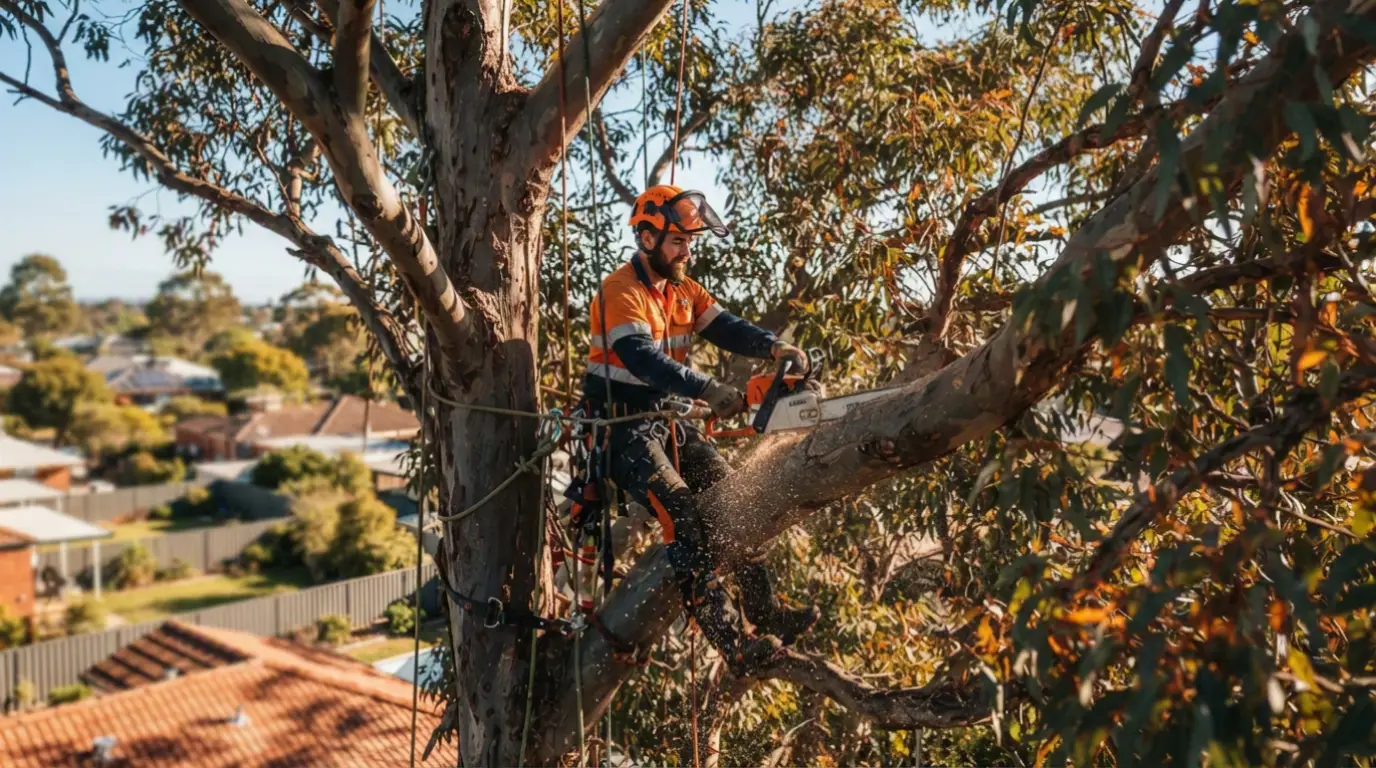
Most Australian homeowners pay somewhere between $1,500 and $3,500 to have a tree removed, and the national median sits at roughly $1,740. The full spread runs from about $500 for a small tree in an open yard to $22,000 for a giant with no safe way in, according to 2026 quote data from Go Tree Quotes.
That's a huge range, and it's why you can never get a straight answer out of anyone. The same 8m tree might be $1,500 standing in an open backyard, and close to $7,000 if it's dead, hanging over powerlines, with no way to get a truck in. What you're paying for is rarely the tree itself. It's everything sitting underneath it.
How much does tree removal cost by size?
Height matters more than anything else, because it decides how the tree comes down. A small one can be felled in a single cut. A big one has to be climbed and taken apart limb by limb, over your roof, by someone who knows what they're doing.
| Tree size | Height | Typical cost (2026, AUD) | What that looks like |
|---|---|---|---|
| Small | Up to 6m | $500-$1,500 | Ornamental, fruit tree, young wattle. Often a half-day job. |
| Medium | 6-9m | $1,500-$3,000 | Established backyard tree. Usually needs a climber. |
| Large | 9-20m | $3,000-$7,000 | Mature gum or camphor laurel. Full crew, sometimes a crane. |
| Extra large | 20m+ | $7,000-$22,000 | Heritage-scale eucalypt. Multi-day, traffic control, crane. |
People always want a price per metre. For a tree in that 9m to 20m band, the tiers above come out to roughly $150-$350 per metre of height. Just don't lean on it too hard, because it falls apart at both ends: small trees work out cheaper per metre, and past 20m the rate climbs steeply, since by then you're really paying for the crane and the crew rather than the timber.
Use it to sanity-check a quote you've been handed, not to price your own tree. No arborist works off a per-metre rate, because the metres aren't what cost them money. The risk is.
Tree removal cost calculator
Set the six things an arborist actually looks at when they walk into your yard, and you'll get the range your quote is likely to land in. It's built on the size tiers above, with the same loadings a real quote carries.
Estimated quote range (2026 prices)
$1,500 - $3,000
A standard two-storey backyard tree with clear access.
Find an arborist near youBased on 2026 Australian price data, in AUD. This is an estimate, not a quote: it can't see your tree, your driveway, or the powerline running past it. Use it to sanity-check the numbers you're given, and always get three written quotes before you commit.
Why is tree removal so expensive?
Because you're not really paying for the cutting. You're paying to get the tree on the ground without it taking your roof, your fence or the climber down with it. Here's what moves the number, roughly in order of how much it hurts.
- Access. The big one. If the truck and the wood chipper (the machine that mulches the branches) can park beside the tree, the timber goes straight from the saw into the chipper. If every piece has to be lugged through a side gate out to the street, the same tree can take twice as long.
- What's underneath. A tree in the middle of a paddock gets felled in one cut. The same tree over your roof has to come apart from the top down, every limb roped and lowered by hand. Slow, skilled, expensive.
- Powerlines. Working near live wires takes special training and legally set clearance distances, and sometimes the power has to be shut off first. Expect a serious jump in price.
- Species. Australian hardwoods are dense and heavy. A 12m gum weighs far more than a 12m pine, so it's slower to cut, the limbs are heavier to lower, and there's a lot more to cart away.
- Condition. A dead or dying tree is unpredictable to climb, because the limbs can snap without warning. Crews add roughly 20-40% for the risk. It sounds backwards, but a dead tree costs more than a healthy one.
- Green waste. The branches, leaves and timber, in other words. Felling the tree is half the job. Mulching the waste and carting it away is the other half, and it's the line most often left quietly off a suspiciously cheap quote.
- Urgency. A tree on your roof at 11pm in a storm is an emergency callout, and it gets priced like one.
What does tree removal cost in your city?
Where you live matters, but less than people expect. Wages, insurance and tip fees (what it costs the crew to dump the timber) all run higher in the big east-coast capitals, so Sydney and Melbourne sit well above the national median, while Hobart and the Gold Coast come in under it.
| City | Average tree removal cost (2026) |
|---|---|
| Sydney, NSW | $2,354 |
| Melbourne, VIC | $2,350 |
| Newcastle, NSW | $1,993 |
| Brisbane, QLD | $1,851 |
| Adelaide, SA | $1,789 |
| Perth, WA | $1,763 |
| Canberra, ACT | $1,740 |
| Gold Coast, QLD | $1,648 |
| Hobart, TAS | $1,643 |
Look at the spread, though. The dearest capital (Sydney) and the cheapest (Hobart) are about $700 apart, while a small tree and a large one are $5,500 apart. Your tree matters far more than your postcode, so don't assume you're being gouged just because you live in Sydney.
Do you have to pay the council as well?
Usually, yes, and it catches people out. In most of Australia you can't just take down a tree on your own land because you've decided you want it gone. In NSW, for instance, you should get advice from your local council before removing any tree, and you may need a permit. Two sets of rules bite at once: a state-wide planning policy (in NSW, the State Environmental Planning Policy for Biodiversity and Conservation 2021) and your own council's Development Control Plan, which is its local planning rulebook. That second one is why the tree your mate pulled out in the next suburb over might be protected in yours.
Victoria runs on local-law permits and Significant Tree Registers. South Australia has a statewide regulated and significant tree scheme. Queensland mostly leaves it to local vegetation protection orders. There's no single national rule, so ring your council before you book anyone.
Two costs to budget for on top of the removal:
- Permit fee: $65-$250. Not much on its own, but take out a protected tree without one and the fines are substantial.
- Arborist report: around $500. Councils commonly want one before they'll approve a removal. It's a written assessment of the tree's health and how likely it is to fail, and not just anyone can write it. If a council, court or insurer is going to act on the thing, it has to come from a consulting arborist holding AQF Level 5, a diploma-level qualification in arboriculture.
There's one exception worth knowing about if you back onto bushland. Under the NSW Rural Fire Service 10/50 vegetation clearing rule, properties inside a designated entitlement area can clear trees within 10 metres of a home, and shrubs within 50 metres, without council approval. Check the RFS online tool on the day you plan to clear, because the eligible areas change.
Is "tree lopping" a cheaper way to do it?
It's cheaper, and that's exactly the problem. Lopping means hacking the limbs off wherever it's convenient, instead of cutting back to a growth point the tree can actually heal from. It's quick, it takes no real skill, and that's why the quote is low.
What you get for the saving is a tree that panics and throws out a mess of weak, badly attached regrowth, which is precisely the sort of limb that comes down in the next big blow. The problem hasn't gone away. You've just pushed it a few years down the track and made the tree more dangerous while you wait. Proper pruning follows the Australian Standard AS 4373, Pruning of Amenity Trees, which is the benchmark Arboriculture Australia, the national industry body, holds the trade to.
So when one quote comes in dramatically under the rest, ask why. Nine times out of ten it's missing the green waste removal, the stump, the insurance, or all three.
How do you get a fair price without hiring a cowboy?
Tree work is about the most dangerous job a homeowner ever hires for. Someone is going up above your house with a chainsaw. The cheapest quote is a rotten place to start.
- Get three written quotes. Not numbers over the phone. Written and itemised, so you can see what each mob is actually including.
- Check the insurance. $10 million public liability is the industry baseline. Public liability is the cover that pays out if they damage your property, so ask to see the certificate. If a limb goes through your roof and the crew turns out to be uninsured, that bill lands on you.
- Check the qualification. Anyone climbing or removing should hold at least AQF Level 3, the Certificate III in Arboriculture, which is the basic trade qualification for tree work. A report your council will act on takes AQF Level 5, a diploma. Arboriculture Australia's Minimum Industry Standards set out what the trade itself considers safe, current practice. If someone can't tell you what they hold, you have your answer.
- Make them itemise the stump and the green waste. These are the two lines that quietly turn a cheap quote into an expensive one.
- Never pay the full amount upfront. A deposit is normal. The whole lot, in cash, before anyone has so much as put a rope in the tree, is not.
Frequently asked questions
Does home insurance cover tree removal in Australia?
Usually only if the tree damaged something insured. Most policies will pay to remove a fallen tree once it has hit your house, but exclude the removal cost if it simply came down in the yard and broke nothing. And if a neighbour's healthy tree falls onto your property, they're generally not liable, so you'll be claiming on your own policy. Read the product disclosure statement, the fine print of your policy, before you assume you're covered.
What is the average cost to cut down a tree?
On 2026 figures the national median is about $1,740, and most people land somewhere between $1,500 and $3,500. It's a blunt number, though. A 5m ornamental in an open front yard and a 25m gum leaning over a roof are both tree removals, and one costs twenty times the other.
How much does it cost to remove a large gum tree?
Budget $3,000 to $7,000 for a gum between 9m and 20m, and $7,000 and up once it clears 20m. Gums are dense hardwood, they get enormous, and they have a habit of growing right over the house. All three push you towards the top of the band.
Is stump grinding included in the price?
Often not. Plenty of quotes cover felling the tree and carting the timber off, then leave the stump sitting in your lawn. Grinding it out usually adds $250 to $1,200 depending on the diameter. Get it itemised on the quote so there's no argument about it later.
How can I save money on tree removal?
Book outside storm season, when crews aren't run off their feet. Bundle several trees into one visit so you're only paying for one setup. Offer to keep the mulch or the firewood, so there's less green waste to cart away. What you shouldn't do is save money by skipping the permit or hiring an uninsured lopper. That's where the real costs are hiding.
Can I remove a tree myself to save money?
For a sapling you can handle with loppers, go for it. For anything with a real trunk, no. You may still need council approval regardless of who swings the saw, your home insurance is unlikely to cover the damage if it goes wrong, and dropping a tree near a fence, a roof or a powerline is genuinely dangerous work. Of all the jobs people take on themselves, this is the one they regret most.
All prices on this page are in Australian dollars and were last reviewed in July 2026. Tree work is quoted job by job, so treat every figure here as a guide to what is reasonable, not a fixed rate. If you are reading this well after 2026, expect the numbers to have crept up.
Ready to get your tree quoted?
Compare qualified, insured arborists across Australia. Free, fast, and no sign-up required.
Find an Arborist Near You