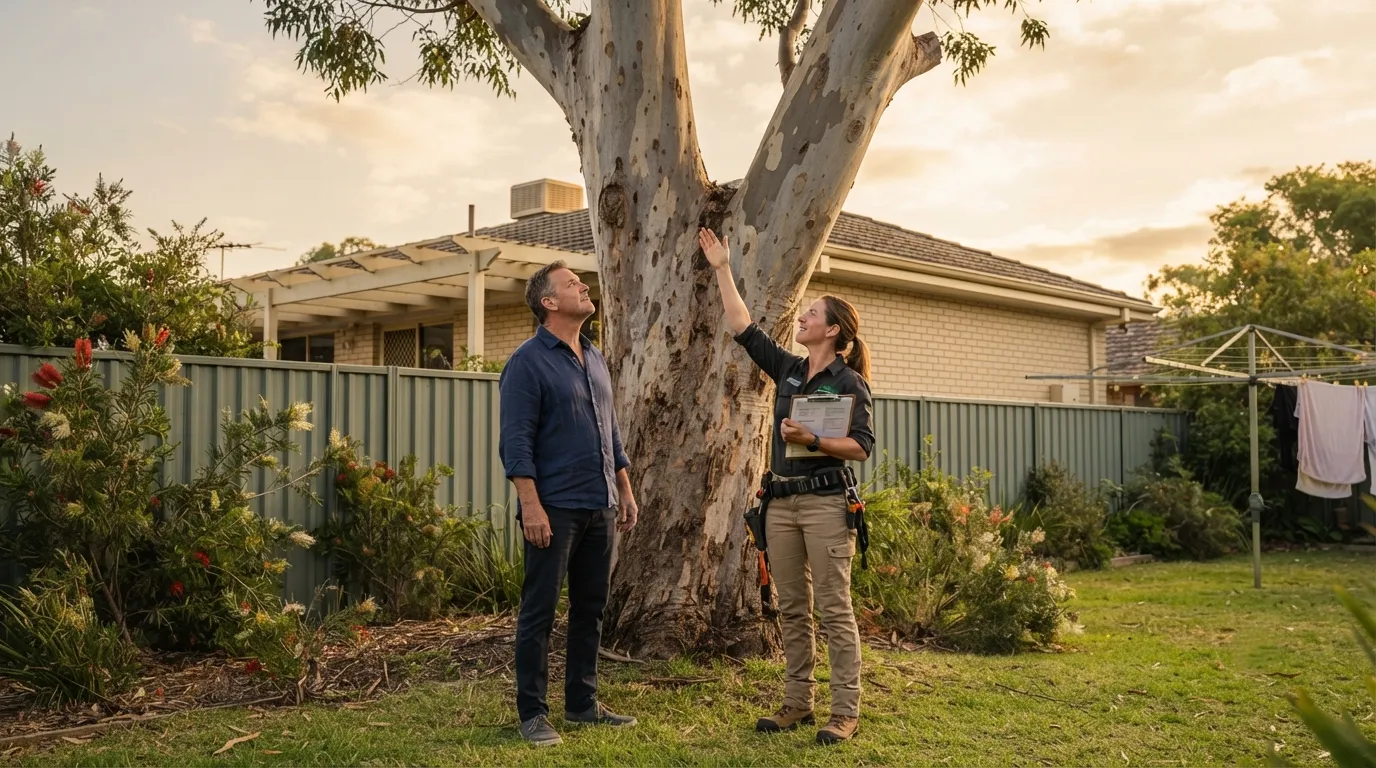
An arborist report is a written assessment of a tree by a qualified arborist, and it is usually the piece of paper standing between you and permission to touch a protected tree. For a single tree you will generally pay $300-$450, with the everyday range landing between $370 and $650, according to 2026 quote data from Go Tree Quotes.
The part that catches people out is not the price. It is the qualification. Councils that ask for a report generally want it signed by an AQF Level 5 arborist, the diploma-level consulting qualification, not the Certificate III a climbing crew holds. Brisbane City Council, for one, names an AQF Level 5 arborist report as supporting information for works on a significant landscape tree. Pay the wrong person and the report comes back unusable.
What is an arborist report?
Brisbane City Council puts it about as plainly as anyone: an arborist report details the structural integrity of a tree and identifies any risks or dangers, and must be lodged by a qualified arborist. It is an expert opinion with your address on it, written so a council officer can act on it.
You will see the same document called a tree report, a tree assessment report or a tree inspection report, depending on which council you are dealing with. One close relative is worth knowing about. A tree risk assessment report is narrower: it sets out the dangers arising from identified faults, damage, defects, pests and diseases, and Brisbane can require it as part of the arborist report if you propose to remove the tree completely or to remove it because of its health.
What a report is not:
- It is not a quote. The consulting arborist who writes it and the crew who do the work are often two different businesses, and it is cleaner when they are.
- It is not a permit. It is evidence you attach to a permit or development application.
- It is not approval. Your council reads it, weighs it against its own assessment, and decides.
How much does an arborist report cost?
Reports are priced on the number of trees and the amount of reading involved, not on how big the tree is. A single backyard gum and a single 30-metre fig take about the same afternoon.
| What you are getting | Typical cost (2026, AUD) | What that covers |
|---|---|---|
| One tree | $300-$450 | Site visit, ground-level assessment, a written report with a recommendation. |
| Four or five trees | Around $700 | One visit, one document. Bundling is where the savings are. |
| Everyday range | $370-$650 | Where most reports actually land, across all types. |
| Development application report | Quoted on scope | Building plans have to be interpreted and protection zones set, so it is more work. No reliable published figure exists, so get quotes. |
Two costs sit alongside it, and neither is included. The first is the removal or pruning itself, which is a separate job at a separate price. Our guide to tree removal costs in Australia covers that side.
The second is the council's own application fee, and this is where a national figure would be meaningless. City of Sydney charges $98 to lodge a private tree application and assesses it in 28 days. Brisbane City Council's protected vegetation permit applications are free. Same country, same job, and the paperwork costs $98 in one city and nothing in the other.
When does a council ask for an arborist report?
There is no national rule, and anyone who gives you one is guessing. Tree approval is set by your state's planning framework and then, in practice, by your own council. In NSW that is spelled out: the rules differ from council to council, the State Environmental Planning Policy (Biodiversity and Conservation) 2021 and Development Control Plans guide many of the decisions, and you should seek advice from your local council before removing any tree. Service NSW is blunt about the consequence on the same page: you may need a permit or approval, and failing to get one can incur substantial fines.
The situations that most often trigger a report are consistent, even when the rules are not:
- The tree is protected and you want it removed. A protected tree is one that needs a separate permit or development consent before it can be pruned or removed.
- You are arguing the tree is dead, dying or dangerous. That is a claim about the tree's condition, and substantiating it is exactly what a report is for.
- You are building. Works near a tree bring a different kind of report, covered further down.
- The tree is on a register or a heritage listing. Trees on a council's significant tree register cannot be removed as part of complying development in NSW.
Notice what the right-hand column does not say anywhere: that a report guarantees anything. Brisbane lists it among the documents you supply to support an application. The decision stays with the council, and that is worth knowing before you spend $400 on the expectation of a yes.
Who can write one, and what is an AQF Level 5 arborist?
AQF stands for Australian Qualifications Framework, the national ladder that ranks every certificate and diploma in the country. In arboriculture two rungs matter, and Arboriculture Australia's industry standards are built around both of them:
- AQF Level 3 is the Certificate III in Arboriculture. The trade qualification: climbing, pruning, removal, the physical work.
- AQF Level 5 is the Diploma of Arboriculture. Consulting work: assessing trees, weighing up risk, and writing the reports councils act on.
Councils say it in almost the same words. Inner West Council: if you require an arborist report you need a consulting arborist with AQF Level 5 or equivalent in horticulture (arboriculture), and a minimum of AQF Level 4 for anyone assessing root pruning. Boroondara tells residents to check for a Level 3 Certificate for pruning and removal and a Level 5 Diploma for consulting services before they even ask for a quote.
Brisbane is the most specific of the three, and it is the one to quote at anyone who bristles at being asked. The arborist writing your report must be qualified to AQF Level 5, carry public liability insurance for $20 million and professional indemnity insurance for $2 million, and produce current certificates if the council asks. Professional indemnity is the cover that pays out when advice turns out to be wrong, which is the risk you are actually buying protection from with a report.
Doing the work is a separate ticket. City of Sydney requires all tree works to be done by a qualified arborist with a minimum AQF Level 3, in line with the SafeWork NSW Code of Practice for the Amenity Tree Industry. So a job can easily involve two arborists, and there is nothing odd about that.
What has to be in the report?
Report contents are set council by council, but Brisbane City Council publishes its checklist in full, which makes it a useful guide to what any council officer is looking for. Brisbane's report must include:
- The arborist's name, company, address, phone number, qualifications and experience.
- The site address and the date of inspection.
- The methods used, such as a resistograph or Visual Tree Assessment. A resistograph is a fine drill that measures how much resistance the timber gives, so decay hidden inside a trunk shows up on a graph. Visual Tree Assessment means reading the tree's shape and defects from the ground.
- Details of the tree: species, height, canopy width, diameter at breast height (the trunk width measured about chest high), where it sits on the block, and observations on its condition, health and structural integrity.
- Recommendations and the reasoning behind them, including any change to a building design and where the tree protection zone should sit.
- Evidence: annotated photographs, test results and statements.
- The sources the arborist referred to or relied on.
Read that list again if you were hoping to download a template and fill it in yourself. The first line is the author's qualifications and the document has to be lodged by a qualified arborist. Your council is checking the signature as closely as the findings.
Do you need one for a development application?
If you are building anywhere near a tree, the document gets bigger and the name usually changes. Brisbane requires an Arboricultural Impact Assessment where construction may affect the root zone of protected vegetation. The works that count are more ordinary than people expect: a new driveway, excavation or fill for a retaining wall, storing materials or machinery, and trenching for plumbing or services.
These reports are written against an Australian Standard, and there is a trap in it worth flagging. The standard is AS 4970, Protection of trees on development sites. Most council pages, arborist websites and report templates still name the 2009 edition, but AS 4970-2009 was superseded on 30 May 2025 by AS 4970:2025, which has itself carried an amendment since December 2025. Ask which edition your arborist is working to. On a development job it is a fair question and a good arborist will have a straight answer.
Pruning has its own standard, AS 4373-2007, Pruning of amenity trees, and councils write it into their permit conditions. Both City of Sydney and Boroondara require pruning to be carried out to it, which is also why Boroondara lists lopping and topping among its unacceptable activities.
Arborist reports in Sydney
In Sydney the answer changes from one council boundary to the next, so the postcode on your rates notice matters more than anything about the tree. Two neighbouring councils make the point.
City of Sydney. You must apply for permission before pruning or removing a tree on a residential or business property, for a $98 fee, assessed in 28 days. Which pathway you are on depends on the tree: heritage-listed trees typically need development consent, while trees protected under the development control plan need a permit. Some trees are exempt from both.
Inner West. A tree works permit is required for most trees unless the job is one of the listed exempt activities, and a report goes in as supporting documentation rather than being mandatory for every application. Complete applications are generally finalised within 28 days, and a fee applies.
Same city, same tree, different paperwork. Before you commission anything, check what your own council requires, and note that some NSW councils accept a private tree permit application through the NSW Planning Portal while others do not.
Arborist reports in Melbourne
In Melbourne the trigger for a report is a local one: a council local law, a planning overlay, or a place on a significant tree register. That means the answer changes at the council boundary, the same way it does in Sydney, and the thresholds are published per council rather than set in one statewide list.
Boroondara is a useful example because it publishes its thresholds. A canopy tree is protected once its trunk circumference reaches 110cm measured 1.4 metres above the ground, or 150cm at ground level. A permit is needed to remove a canopy tree or work within 2 metres of its trunk, and to prune, remove or work inside the tree protection zone of a significant tree. Significant trees are the ones listed on the council's significant tree register, picked for size, age, rarity, ecological value or history.
The line every Melbourne homeowner should read before hiring anyone is Boroondara's own warning: if a protected tree is removed without a permit or damaged during works, even if the arborist told you no permits were needed, you and the arborist could be fined or prosecuted. "My tree guy said it was fine" is not a defence.
How do you hire a consulting arborist?
A report is a professional service, so treat it like hiring an engineer rather than booking a crew.
- Ring your council first and ask exactly what they want. Which report, which AQF level, which format. A report written to the wrong requirement is $400 gone.
- Ask for the qualification by name. Boroondara's advice is to check credentials before you request a quote, not after.
- Ask for the insurance certificates. Brisbane requires the report author to produce current certificates on request, so a consulting arborist should hand them over without fuss.
- Get the scope in writing. How many trees, whether building plans are being read, whether a tree protection plan is included, and how long the report takes.
- Use one visit for every tree you might touch. The pricing rewards it heavily.
- Walk away from door-knockers. Boroondara says it outright: do not hire door-knockers who push you to agree to urgent works for a cash payment.
And be honest with yourself about the outcome you want. If the report says the tree is healthy and should stay, you have still bought something useful: you now know the tree is sound, and you have not spent thousands finding out the hard way.
Frequently asked questions
Do I need an arborist report to remove a tree?
Not always, and there is no national rule that settles it. In NSW the State Environmental Planning Policy (Biodiversity and Conservation) 2021 and your council's Development Control Plan set the framework, and Service NSW's advice is to seek advice from your local council before removing any tree. Some councils treat a report as optional supporting material, others require one for particular trees. Ask before you pay for anything.
Does an arborist report guarantee council approval?
No. Brisbane City Council lists an AQF Level 5 arborist report among the documents you supply to support your application, not as the decision itself. The report is evidence. Your council weighs it against its own assessment and still makes the call, and a report that recommends keeping the tree is an outcome you should be ready for.
What is the difference between a tree report and an arborist report?
Usually nothing. Councils use different names for the same document, and you will also see tree assessment report and tree inspection report. Brisbane City Council does separate two of them: an arborist report covers a tree's structural integrity and the risks it presents, while a tree risk assessment report focuses on the dangers arising from identified faults, damage, defects, pests and diseases, and can be required as part of the arborist report.
Can a Level 3 arborist write my report?
Not where your council has specified Level 5. Inner West Council requires a consulting arborist with AQF Level 5 or equivalent when a report is called for, and Brisbane City Council requires AQF Level 5 for works relating to a significant landscape tree. AQF Level 3 is the qualification for doing the physical work, and City of Sydney sets it as the minimum for that.
How long is an arborist report valid for?
There is no single rule, and any cut-off comes from your council rather than from a standard. What is fixed is that a report has to carry the date of inspection, because that sits in Brisbane City Council's report checklist. A tree's condition changes from season to season, so an old report invites questions. Ask your council whether it applies a time limit before you commission one.
Can I use an arborist report template instead of paying for one?
No. Brisbane City Council requires the report to be lodged by a qualified arborist and to state that arborist's name, company, qualifications and experience, along with the inspection date and the methods used. A template with your own name on it fails on the first line. Templates are useful for seeing what you are buying, not for replacing it.
All prices on this page are in Australian dollars and were last reviewed in July 2026. Council fees, permit thresholds and report requirements are set council by council and change over time, so treat every figure and rule here as a starting point and confirm the detail with your own council before you commit.
Need an arborist report?
Compare quotes from qualified, insured consulting arborists across Australia. Free, fast, and no sign-up required.
Find an Arborist Near You