A single stump ground out in an Australian backyard runs from about $60 for a narrow one to $590 for something enormous, and the price tracks one thing above everything else: the diameter of the cut. If you already know what you want gone, skip the theory and get three quotes from arborists near you. If you'd rather know what you're being quoted on first, that's what the rest of this page is for.
Be careful with national averages, including the ones behind this page. Go Tree Quotes puts the figure at $95 a stump in its stump grinding cost guide and at $225 a stump, ranging $75 to $450, in its stump removal cost guide. Same site, same year, two numbers that don't agree. Neither is wrong exactly. They're just not describing the same job, which turns out to be the first useful thing to understand about this trade.
What is the difference between stump grinding and stump removal?
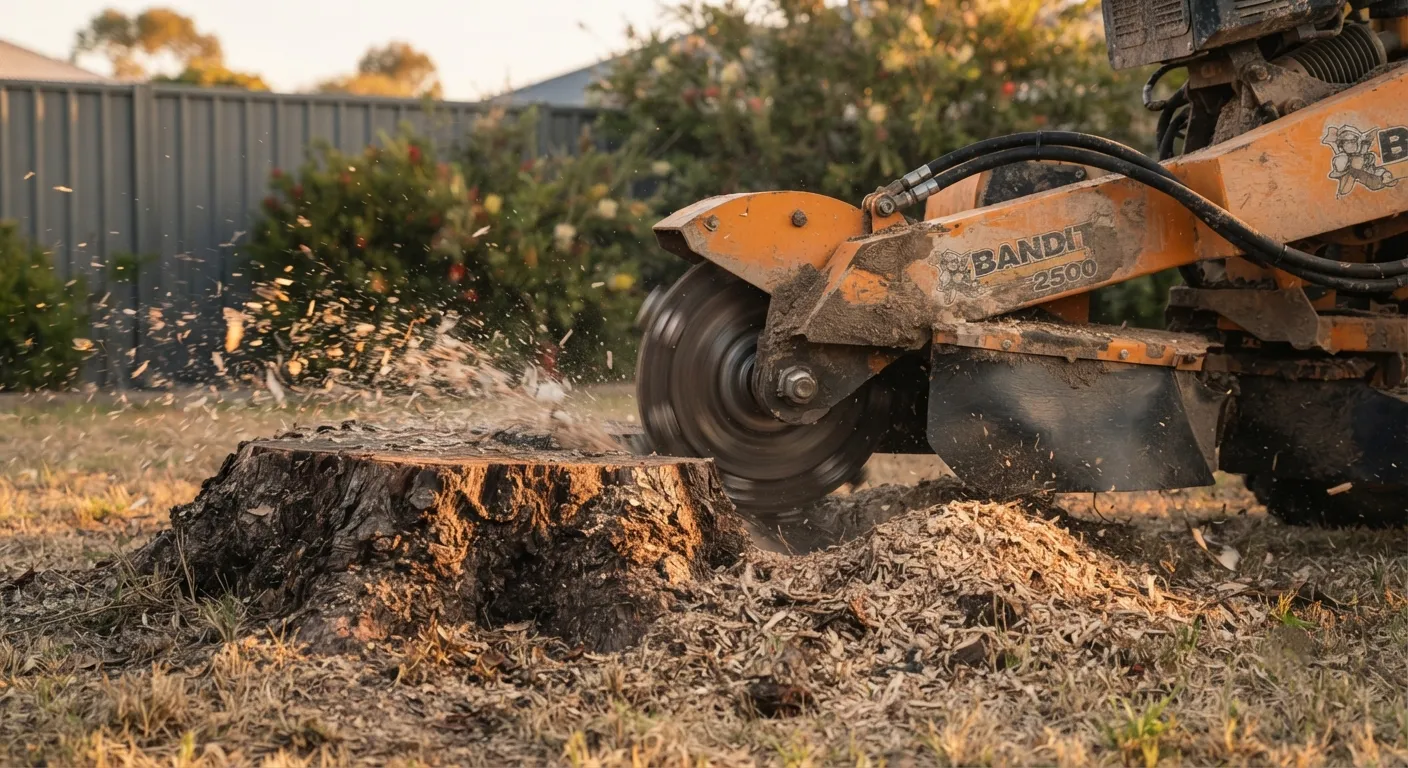
Stump grinding means shaving the stump away with a spinning cutting wheel until it sits below the level of your lawn, then backfilling the hole with the chips the machine has just made. The root system stays in the ground and breaks down on its own over the following years.
Stump removal, read literally, means dragging the whole root ball out with an excavator. It leaves a crater, it tears up whatever is growing within a few metres, and on a mature gum it is a serious earthmoving job rather than a tree job.
Here's the part the search results never tell you: when an Australian arborist quotes you for "stump removal", they are nearly always quoting you for grinding. The two phrases describe the same purchase. You can watch it happen in the trade's own pricing pages, where the stump removal guide spends its time explaining grinding out your stump and treats the excavator as the exception, for when something is going up against a fence, a foundation or a pool. So the honest rule is to ask for full excavation only when you're building over the spot, which is worth its own conversation further down.
How much does stump grinding cost in Australia?
Diameter is the number the whole quote is built on. Measure across the widest part of the cut, not the trunk you remember from three metres up. The rule of thumb the trade works to is to multiply the diameter in centimetres by three, then stretch that to four and a half where access, roots or dense hardwood make the job harder. On a 25cm stump that's about $75. On an 85cm stump it's $255 to $380.
| Stump diameter | Typical cost (AUD) | Palm stump | What that usually is |
|---|---|---|---|
| 15-25cm | ~$60 | ~$45 | An ornamental, a young wattle, a fruit tree |
| 25-40cm | ~$100 | ~$85 | A settled garden tree, ten or fifteen years old |
| 45-60cm | ~$180 | ~$110 | An established liquidambar or small gum |
| 65-80cm | ~$290 | ~$180 | The big one at the back of the yard |
| 85-120cm | ~$385 | ~$250 | A properly old eucalypt |
| 120-150cm | ~$590 | ~$420 | Heritage scale, and a multi-pass job |
Palm stumps come in cheaper at every size because palm fibre cuts nothing like eucalypt hardwood. It shreds. Hardwood blunts teeth. The table stops at 150cm because that's where the published data stops, not where the prices do: the same source puts the top of the market at $900, and a genuinely enormous stump in a bad spot will beat that.
Two things a table can't show you. The first stump is priced to cover getting the machine to your address, so the second and third stumps in the same visit cost far less than the first - if you have three to do, do them together. And if you're booking stump work on its own, with no tree removal attached to it, ask whether there's a minimum charge. On a small stump the travel really is most of the job.
What makes one stump dearer than the next?
Two stumps of identical diameter can be $150 apart. This is what the arborist is sizing up while they're standing in your yard.
| Cost factor | Why it moves the number |
|---|---|
| Diameter at the cut | The base of the quote, and the only figure most crews price off. |
| Access | The machine has to physically reach the stump. A narrow side gate forces the crew onto a smaller grinder, and a smaller grinder takes longer on the same timber. |
| Grinding depth | Just under the turf is cheap. Deep enough to replant, pour a slab or run a trench means more passes and more spoil to deal with. |
| Surface roots | Buttress roots flared out across the lawn are extra metres of grinding that the diameter never captured. |
| Number of stumps | Setup is a fixed cost. Batching several into one visit is the single biggest saving available to you. |
| What's buried | Water, gas, power, telecoms and irrigation all sit at grinder depth. Locating them is time before the machine even starts. |
| Where the grindings go | Left in the hole as backfill, they're free. Carted off site, they're a green waste charge. |
| Metal and rock | Old fencing wire, star pickets, concrete and stone chew through cutting teeth, and teeth are not cheap. |
Does stump and root grinding take the roots out too?
Mostly no, and the phrase oversells what happens. A standard grind takes the stump and the flare of buttress roots immediately around it. The lateral roots running out under your lawn stay exactly where they are and rot down over several years.
There's a hard limit on the machine, too. Stump grinders are not designed to go much deeper than about a foot below the surface, which is roughly 30cm. That's plenty for a lawn, a garden bed or a new tree planted a metre to one side. It stops being enough the moment you want to build.
So if a driveway, a slab, a retaining wall or a pool is going over that spot, say so when you ask for the quote. You're describing a different job: deeper work, roots chased out along their length, and quite possibly an excavator after all. Finding that out after the crew has packed up is how a cheap stump becomes an expensive one.
Why not just leave the stump in the ground?
Because a rotting stump is close to ideal habitat for termites. Victoria's Department of Health, writing about Coptotermes, the genus it holds responsible for more than 80 per cent of termite damage to buildings in that state, notes that they build nests in trees (preferring eucalypts) and stumps, and that the workers travel at least 50 metres from the colony through underground tunnels to find food. Fifty metres, on a standard suburban block, is your house, your neighbour's, and everything between them.
Victoria's Building and Plumbing Commission says the same thing from the building side. In its termite guidance, the risk of attack can be reduced by removing tree stumps, roots and off-cuts, and by consolidating the soil so slabs don't crack.
The rest of the case is duller and still true. A stump is a trip hazard where kids run. It kills mower blades. It sprouts. And it sits on the one flat patch of the yard you actually wanted to use, which is usually the reason the tree came down in the first place.
Is poisoning a stump cheaper than grinding it?
Cheaper, yes. A solution to the same problem, no.
Poisoning kills a stump. It does not remove one. The method professionals use is cut stump application: herbicide painted or gelled straight onto the cut face within seconds of the saw lifting off, before the wound seals itself. It's a recognised technique, not a shortcut, and NSW's weed authority lists it among the standard control methods for camphor laurel, alongside stem injection and basal bark treatment. It is genuinely the right tool for one specific job: stopping a species that resprouts from coming back as a thicket of shoots.
It's the wrong tool if the lump in your lawn is the problem. Twelve months on you have the same lump, only dead, and someone still has to grind it. Any herbicide also has to be used according to its label. So if regrowth is your worry, tell the arborist what species it is and have them treat the cut on the day they fell it, then have the stump ground out. Doing both is not the expensive option. Doing one, then discovering you needed the other, is.
How do you choose a qualified, insured stump removal service?
A stump grinder throws chips, grit and whatever metal it finds at speed, and it does that within a metre of your fence, your windows and your feet. Of everything on a tree job it's the machine most likely to break something. Four things worth checking before you book.
- Check the qualification. Arboriculture Australia, the national industry body, registers practising arborists at AQF Level 3, the Certificate III in Arboriculture, and consulting arborists at AQF Level 5, the Diploma. Grinding and removal is Level 3 work. Level 5 is for the person who writes the report a council will act on, which is a different purchase entirely.
- Check the insurance, and know what the figure means. Arboriculture Australia requires proof of public liability cover to a minimum value of $5 million for registered members, with $2 million professional indemnity on top for the consulting grades. That's a floor for registration, not a market average, and plenty of firms carry a good deal more. Ask to see the certificate rather than the claim.
- Ask who checks for underground services. Before You Dig Australia runs a free enquiry that returns information about the underground networks at your site without you contacting each utility separately, and it asks homeowners to lodge that enquiry before any contractor starts excavation work on the property. Grinding is excavation, and BYDA's own warning to homeowners is that asset owners may seek compensation for damage you cause to their assets. A crew who've never heard of any of this are telling you something about how they work.
- Get it itemised in writing. Depth, number of stumps, whether surface roots are included, and whether the grindings stay in the hole or get carted away. Those four lines are where a cheap quote and an expensive one turn out to be the same price.
Do you need council approval to remove a stump?
Usually the stump is the easy part. The regulated thing was the tree.
In NSW, Service NSW says the rules differ from council to council, that you should seek advice from your local council before removing any tree, and that failing to do so can incur substantial fines. Victoria's guidance has the same shape: trees can be covered by council rules, so check with your council whether the tree is protected before anyone touches it. South Australia runs a statewide regulated and significant tree scheme; Queensland leaves most of it to local vegetation protection. There is no national rule, and there never has been.
Where that leaves you is simple enough. If the tree is already down, you're past the approval question and grinding what's left is your business. If it's still standing, the stump is the tail end of a removal that may need approval first, and possibly an arborist report to go with the application. The tree removal cost guide covers what that whole job runs to.
Perth is the one place the stump itself is regulated. The polyphagous shot-hole borer has put the entire Perth metropolitan area, across 30 local government areas, inside a Quarantine Area Notice since it was extended on 6 September 2024. It splits the city into two zones, and which boundary binds you depends on the zone you're in: from Zone A, untreated or unseasoned wood cannot be moved outside Zone A; from Zone B, it cannot be moved outside the Quarantine Area. The exception is the same either way, and it's the one that matters here: wood chipped to pieces 2.5cm or less in diameter. The rule people miss is the second one. Any machinery used to handle green waste has to be cleaned before it crosses that same boundary, and a stump grinder is exactly that machinery.
Grass and lawn clippings are exempt, because they don't host the beetle. So is treated timber, and seasoned timber over six months old that's already in use as construction, fencing, furniture or pallets. A stump and its grindings are none of those. Anyone who can't meet the requirements has to contact DPIRD for a permit before moving the material, which makes this a question worth asking the crew before they quote, not after they've loaded the trailer.
Find stump grinding and stump removal near you
Stump work is priced locally and quoted on sight, so the fastest way to a fair number is three quotes from crews already working in your suburb. Pick your city, or search the whole directory.
Frequently asked questions
How much does stump grinding cost per stump?
Around $60 for a stump 15cm to 25cm across, and roughly $590 once you get past 120cm. Palm stumps run cheaper than hardwood at every size. The quickest sanity check on a quote is to multiply the diameter in centimetres by three, then by four and a half if access is awkward or the roots are up out of the ground.
Is stump grinding cheaper than stump removal?
Yes, and in Australia the two words usually describe the same job anyway. Almost nobody digs a root ball out with an excavator now, so a quote headed stump removal is nearly always a quote for grinding. If you genuinely need the whole root system out, because a slab or footings are going over the spot, say so up front. That is a bigger machine and a bigger number.
How long does it take to grind a stump?
A small garden stump is often done inside half an hour, including setup. A wide hardwood stump with the roots flared out can run to half a day. What blows the time out is rarely the timber. It is carrying the machine through a side gate, working around a fence, or hitting old wire and rock in the soil.
Can I grind a stump myself with a hired machine?
You can hire one, but it is the wrong job to learn on. A grinder weighs a couple of hundred kilos, needs loading and unloading, throws grit and stones at speed, and sits at exactly the depth your water, gas, power and irrigation lines run. On a single small stump the hire fee plus the trailer usually lands close to what an arborist would charge, and they carry the insurance.
Will the stump grow back after grinding?
Not the stump itself, but some species send up shoots from the lateral roots left in the ground. Camphor laurel is the one arborists mention first, and a lot of the declared weed species do the same. If you know the tree is a resprouter, tell the arborist before they cut, because a herbicide treatment painted onto the fresh cut face is far more effective than anything done weeks later.
Do I need council approval to grind a stump?
Generally not, if the tree is already down. The regulated thing was the tree. If it is still standing, the stump is the tail end of a removal that may well need approval first, and the rules differ from council to council. Perth is the exception worth knowing: the whole metropolitan area sits inside a shot-hole borer quarantine that restricts moving wood and green waste, and the grindings count.
All prices on this page are in Australian dollars and were last reviewed in July 2026. Stump work is quoted on sight, so treat every figure here as a guide to what is reasonable rather than a fixed rate. We are a directory, not a tree service: we do not quote, book or carry out the work, and enquiries go straight to the business.
Ready to get that stump out?
Compare qualified, insured arborists across Australia. Free, fast, and no sign-up required.
Find a Stump Removal Arborist Near You