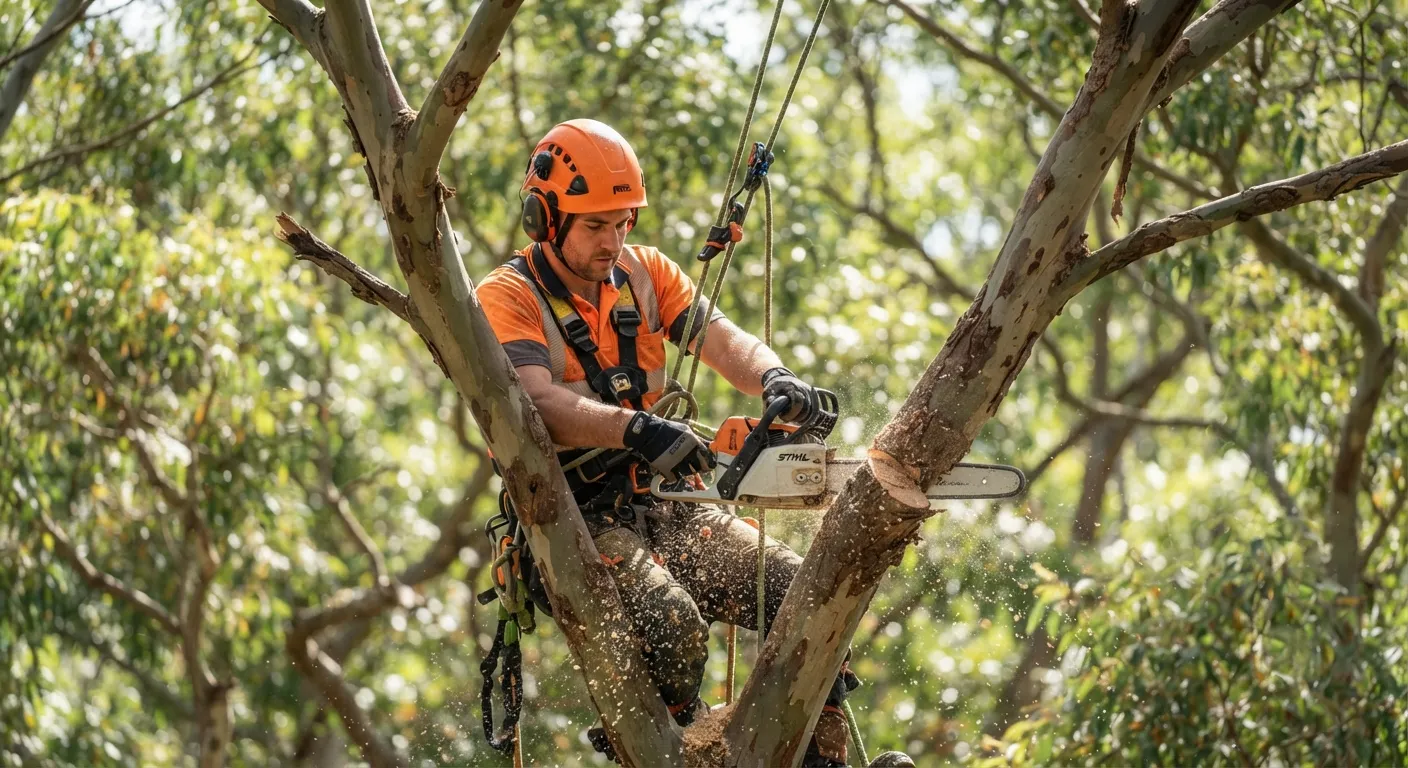
Most people ring an arborist and ask what pruning a tree costs. The useful question is which cut the tree needs, because that is what the price is attached to. Lifting a canopy clear of a driveway starts around $200. Thinning the crown of a mature 20-metre tree runs to $2,000. Same tree, same crew, ten times the difference, and the word "pruning" covers both. If you already know roughly what you want done, put it in front of arborists working in your postcode. If you want to walk into that conversation knowing the vocabulary, the rest of this page is for you.
What does tree pruning actually involve?
Pruning means taking selected branches off a tree in a way that lets the wound seal, rather than shortening whatever is in reach. The cuts have names, and those names are not marketing. They are defined terms in AS 4373-2007, Pruning of amenity trees, the Australian standard for this work. It replaced the 1996 edition, was reconfirmed in September 2020, and remains current. When a quote says "crown thinning", it is using a word with a published meaning, and you can hold the crew to it.
Four cuts cover most residential jobs:
- Crown lifting. Removing the lowest branches so the canopy sits higher. This is the one people want when a tree is scraping the roof, blocking a driveway or hanging over a footpath.
- Crown thinning. Selectively taking out interior branches to reduce canopy density without changing the tree's shape or height. It lets light and wind through rather than making the tree smaller.
- Reduction pruning. Shortening the outer limbs back to suitable growing points to reduce the tree's overall size. This is the heavy one, and the one most often done badly.
- Deadwooding. Removing dead and dying branches. Purely a safety job, and the one worth doing on a schedule, because dead limbs are what fall on cars and sheds without warning.
The standard also covers the unglamorous parts, including disinfecting equipment between cuts, which matters more than it sounds when a crew moves from a diseased tree to a healthy one on the same afternoon.
Is tree trimming the same as tree pruning?
For the purposes of hiring someone, yes. Australian crews advertise as tree trimming, tree pruning, or both at once, and the quote you get will be identical. "Trimming" is the everyday word for tidying a canopy; "pruning" is the word on the standard, on council permit forms and in an arborist's qualification. Nobody in the trade will correct you, and no one charges differently for the word you used. What moves the price is which of the four cuts above the tree actually needs, and how far off the ground the work happens.
Hedges are the genuine exception. Shearing a hedge to a shape is a different job with different tools and a different price, usually charged by the metre rather than by the tree.
How much does tree pruning cost?
Between about $150 and $2,000 per tree. Before the tables, a warning about where Australian pruning prices come from. Go Tree Quotes publishes the most-cited pruning cost guide in the country, and on one page it gives three incompatible answers for the top of the range: $1,450 in its opening paragraph, $1,800 in its summary table, and $2,150 in the size-by-size breakdown further down. Its small-tree band appears twice as well, once as $250 to $350 and once as $325 to $450. We have priced this page off its cut-by-cut figures instead, which are internally consistent and, more to the point, are how the work is actually quoted.
| Type of cut | Typical price (AUD) | What you are paying for |
|---|---|---|
| Crown lifting | $200 - $700 | The lowest branches, worked from the ground or a short climb. Least time aloft, so the cheapest cut on the list. |
| Deadwooding | $150 - $1,500 | $150 to $600 on a 5 to 10 metre tree, $400 to $1,200 at 10 to 20 metres, and up to $1,500 above that. All the cost is climbing time. |
| Crown thinning | $300 - $2,000 | $300 to $600 at 5 to 8 metres, $600 to $1,200 at 8 to 15 metres, $1,200 to $2,000 at 15 to 25 metres. Slow work, because every branch is an individual decision. |
| Reduction pruning | $350 - $1,500 | The climber works out to every extremity of the tree and takes a set proportion off. Priced on canopy size, not trunk height. |
| Crossing or rubbing branches | $100 - $800 | A structural fix, best done young. Cheap on a sapling and expensive once the union is thirty years old. |
What changes the price of a pruning job?
Two crews can quote the same tree hundreds of dollars apart without either being wrong. These are the variables they are weighing while they stand in your yard.
| Cost factor | Why it moves the number |
|---|---|
| Height and how they get up there | A tree an arborist can reach from a pole saw is a different job from one needing a rope-and-harness climb, which is different again from one needing an elevated work platform hired for the day. |
| What is under the canopy | Branches dropped onto open lawn cost nothing extra. Branches lowered on ropes past a pergola, a pool fence or a colorbond roof are rigged individually, and rigging is time. |
| Species and canopy density | An open-branched jacaranda thins in an hour. A dense mature fig or a multi-stemmed melaleuca takes most of a day for the same visual result. |
| Powerlines | Anything close to the network needs accredited workers and, sometimes, coordination with the distributor. It affects both price and lead time. See the section below. |
| Green waste | Chipped on site and taken away is standard and usually included. Palm fronds are the exception, because they cannot be mulched and leave as general waste. |
| Council paperwork | If your council requires a permit to prune, someone has to lodge it, and some crews charge for that while others decline to do it at all. |
| Season | Spring and summer are peak for tree crews. Booking in the quieter months generally buys you a better price and a shorter wait. |
| Minimum charge | Almost every arborist has a floor for turning up. On a single small job that minimum, rather than the work, is what you are paying. |
Do you need council approval to prune a tree?
This is where pruning surprises people. Homeowners generally know removing a tree can need approval. Far fewer know that in many councils, pruning a tree you own needs it too, and that the amount you may take without asking is set locally. Three councils in and around Sydney give three different answers, which is the clearest illustration available that there is no national rule.
| Where you are | How much you can prune before you need approval |
|---|---|
| Northern Beaches, NSW | Up to 10% of a tree's canopy within 12 calendar months, and the council specifies that the work must be done in accordance with AS 4373-2007. Deadwood removal is separately exempt. |
| City of Sydney, NSW | Half that. A permit is not required provided the pruning does not remove more than 5% of a tree's canopy, stays inside published clearance limits, and is done by an arborist qualified to a minimum of AQF Level 2. |
| Blue Mountains, NSW | No percentage allowance at all. A council permit is needed to remove or prune a tree four metres or more in height, or with a crown spread over four metres, and to touch any mallee-form eucalypt regardless of size. |
| South Australia | A statewide test rather than a number. For a regulated or significant tree, approval is not needed for pruning that is not likely to affect the health or appearance of the tree. That is a judgement call, which is a good reason to have a qualified person make it. |
| Victoria | No statewide private-tree scheme. Council rules and planning overlays decide, so check with your council whether the tree is protected. Victoria does give you a right of abatement over the boundary, at your own cost. |
| Queensland | Local laws and planning schemes. In Brisbane, work on protected vegetation is permit-controlled, and the council may want an arborist report with the application. |
Two practical consequences. First, "it's only a prune" is not a defence anywhere, and the penalties attach to the work, not to the intention. Second, the council covering your address is the only authority on your address, so the five minutes it takes to ring them is the cheapest part of the job. Where an application does need supporting evidence, that usually means an arborist report.
Pruning near powerlines is not a DIY job
Of everything on this page, this is the part with a legal answer rather than a judgement. In New South Wales, Ausgrid states that any tree trimming performed within three metres of its powerlines must only be done by workers accredited under the SafeWork code of practice for work near overhead powerlines. Not "should". Must. The clearance the network itself maintains varies from 0.5 to 6 metres depending on species, location and bushfire risk.
Endeavour Energy, covering the rest of Sydney's west and the Illawarra, puts the homeowner's side of it plainly: you are responsible for keeping trees that grow on your property a safe distance from powerlines, and it advises maintaining a three metre clearance and using a professional tree trimmer. Every state has its own distributor with its own accreditation scheme, so the names change while the principle does not. The tree is yours to maintain. The cutting near the wires is not yours to do.
Why "tree lopping" is not what you want
Lopping is cutting limbs back to stubs at convenient points instead of at the tree's natural growing points. It is quick, it is cheap, and it is the reason so many suburban trees carry a dense brush of weak regrowth a few years later, sitting on wounds that never sealed. Topping, taking the whole head out of a tree to shorten it, is the same mistake at full scale.
Neither is slang. Both are defined terms in AS 4373 alongside the cuts described earlier, which means an arborist reading a quote can tell instantly which one you have been sold. Councils know the difference too. Northern Beaches Council lists "requests for lopping or topping of trees" among the things it will not approve, along with pruning contrary to the standard, and pruning beyond what a species tolerates, giving the example that figs pruned by more than 10% become prone to sunburn. Ask for reduction pruning by name and you will get a different job from the one "lopping" buys, usually for a similar price.
How to choose a qualified, insured tree pruning service
Pruning looks less risky than removal, so people vet the crew less carefully. That is backwards. A bad removal leaves you with a stump. A bad prune leaves you with a damaged tree you will be paying for over the next decade, and possibly a council letter.
Ask for three things:
- A qualification that matches the cut. Notice that the City of Sydney exemption above does not merely permit 5%, it names who may take it: an arborist holding at least AQF Level 2. Even the light work has a floor. The rungs above it are the ones Arboriculture Australia registers, Level 3 for the person in the tree with the saw and Level 5 for the consultant writing what a council will read. For a straightforward crown lift you want the middle rung, held and current.
- The certificate of currency, not the claim. The industry body's own minimum sits at $5 million public liability, rising by $2 million of professional indemnity once someone is advising rather than climbing. Treat that as the entry price for registration, not as what the market carries. Individual regulators go much higher for particular jobs, and Brisbane is the sharpest example: report on vegetation the council protects there and it wants $20 million of cover behind you. Whatever the figure, ask for the document.
- The cut, in writing. "Prune the gum" is not a scope. "Crown lift to 3 metres over the driveway and deadwood the northern side, to AS 4373" is. Naming the standard in the quote is the single most useful sentence you can add, because it converts a vague tidy-up into something with a benchmark.
If the tree turns out to be past pruning, that is a different service and a different conversation: see tree removal, and stump removal for what gets left behind.
Find tree pruning near you
Pruning is priced on sight, and the councils above show why local knowledge is worth as much as the quote. A crew that works your area already knows whether your council wants a permit before anyone climbs. Pick your city, or browse the whole directory.
Frequently asked questions
How much does tree pruning cost in Australia?
Between roughly $150 and $2,000, because pruning is quoted by the cut rather than by the tree. Lifting a canopy off a driveway is the cheap end at $200 to $700. Thinning a mature 15 to 25 metre tree is the dear end at $1,200 to $2,000. Deadwooding sits between the two, from $150 on a small tree to $1,500 on a very large one. Ask which cut you are being quoted for and the number stops looking arbitrary.
Do I need council approval to prune a tree?
Quite possibly, and the threshold is local rather than national. Three Sydney-area councils illustrate how far it varies: Northern Beaches lets you take up to 10% of a canopy in 12 months, the City of Sydney allows 5% and only by a qualified arborist, and the Blue Mountains requires a permit to prune any tree four metres or taller at all. Ring the council covering your address before the crew arrives.
My quote says lopping. Is that the same thing?
No. Pruning removes selected branches at the right points so the tree can seal the wound, while lopping shortens limbs wherever is convenient. Both terms are defined in the Australian standard for pruning amenity trees, so an arborist knows exactly which one you have been sold, and some councils will not approve lopping or topping at all. There is a fuller answer, and what to ask for instead, on the tree lopping page.
Is tree trimming the same as tree pruning?
In practice, yes. Australian tree crews advertise under both words and quote the same work either way. Trimming is the word people reach for when they mean tidying a canopy, and pruning is the word on the standard and on council paperwork. What actually changes the price is which cut you need, not which word you searched.
Can I prune a tree near powerlines myself?
No. Ausgrid states that any tree trimming within three metres of its powerlines must only be done by workers accredited under the SafeWork code for work near overhead powerlines, and Endeavour Energy tells property owners to keep a three metre clearance and use a professional tree trimmer. The tree may still be your responsibility to maintain, but the cutting near the wires is not a job you can do yourself.
When is the best time to prune a tree in Australia?
It depends on the species and on why you are pruning, which is a genuine answer rather than a dodge. Dead and hazardous wood comes out whenever it is spotted. Heavier structural work is usually timed to the tree's quieter growing period. Spring and summer are the busy season for tree crews, so booking outside it tends to get you a better price and a shorter wait.
Figures on this page are Australian dollars, reviewed August 2026, and drawn from published Australian pruning rates rather than from quotes we issue. Council rules were read on each council's own site on the date of review and can change without notice, so confirm yours before booking. We are a directory: we do not quote, schedule or perform tree work, and every enquiry goes directly to the business you contact.
Need a tree pruned properly?
Tell local arborists which cut you need and let them quote it. No account, no cost, no obligation.
Find a Tree Pruning Arborist Near You