Taking a tree out in Australia lands somewhere between about $500 and $22,000, and most suburban jobs finish between $1,500 and $3,500. That spread looks absurd until you realise what you're actually buying. A five-metre lilly pilly in an open front yard and a fifteen-metre gum leaning over the neighbour's roof are the same two words and completely different work. If the tree already has to go, compare arborists working in your area. If you want to understand the number before somebody says it out loud, keep reading.
One caution about where those figures come from. Go Tree Quotes is the most-quoted pricing source in the Australian trade, and on a single page it puts the national median at $1,740, then lists Sydney at $2,354 as "+9.06%" above that median and Melbourne at $2,350 as "-2.17%" below it. Both cannot be right, and neither percentage matches its own dollar figure. The size bands further down are the usable part. The city averages are noise.
What does a tree removal service actually include?
Two methods, and which one you get is decided by your block, not your budget.
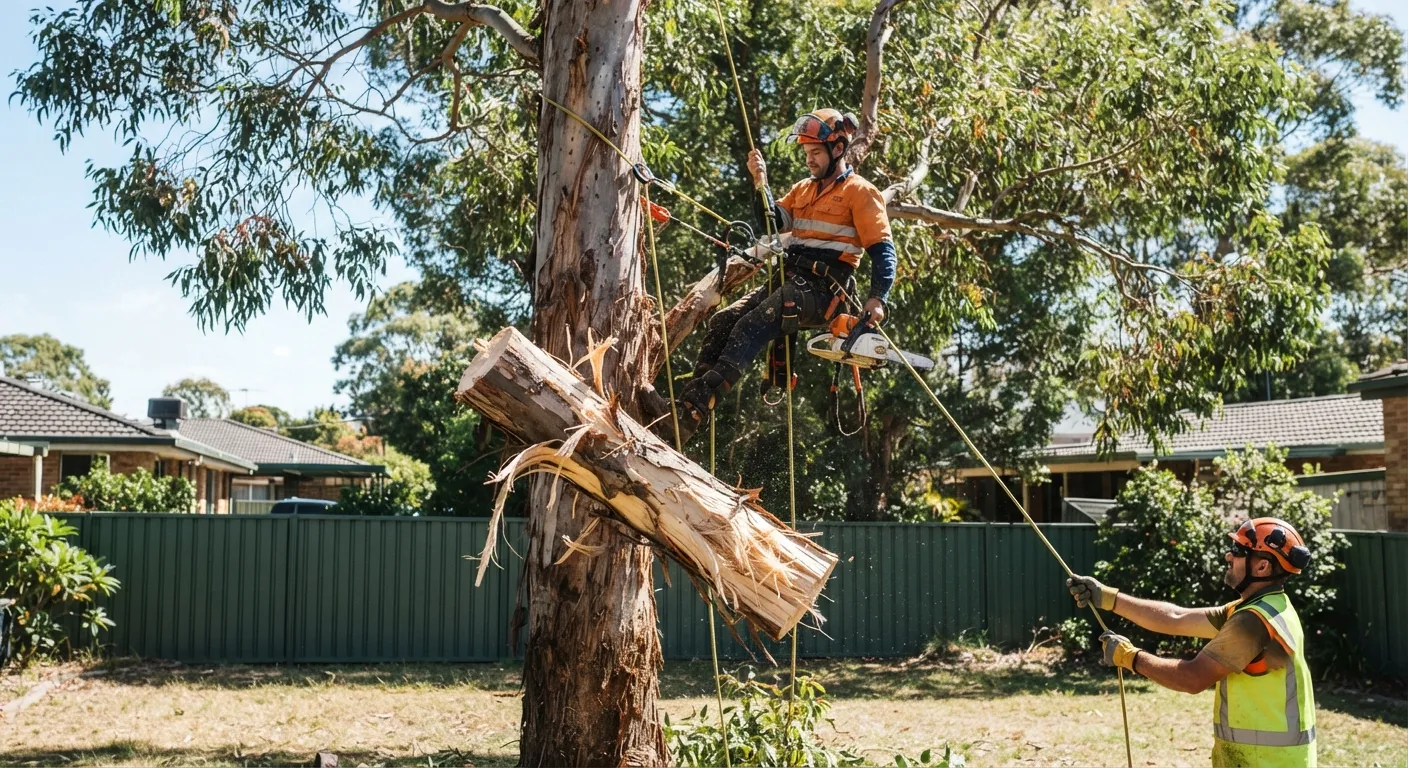
Felling is cutting the tree at the base and dropping it whole. It needs a clear landing strip roughly as long as the tree is tall, which almost no suburban yard has. Sectional dismantling is the alternative: a climber, or a crew working from an elevated work platform, takes the tree down in pieces and ropes each piece to the ground instead of letting it fall. Large gums near buildings almost always need section-by-section lowering rather than felling, and even a modest job runs a minimum of three trained crew: someone aloft, someone on the ropes, someone feeding the chipper.
What a standard quote normally covers is the take-down, cutting the timber to a manageable size, chipping the branches, and raking the site clean. What it frequently does not cover is the part people assume:
- The stump. Usually a separate line, sometimes a separate visit. Ask before you sign, because a ground-level cut leaves you a lump in the lawn. Our stump removal service page covers what that costs on its own.
- Palm material. Palm fronds and trunk can't be mulched, so they leave as general waste and get charged accordingly.
- Root work. Chasing lateral roots out of a lawn or away from a slab is excavation, not tree work, and it is priced separately.
- The paperwork. Some crews will lodge a council application for you and some won't touch it. Worth establishing early.
What a tree removal quote is built on
Height is the first thing an arborist measures and the single biggest driver of the number, because height decides the method, the crew size and the risk. The bands below, and the factors in the table after them, come from the same Australian pricing data as the figures at the top of this page.
| Tree height | Price range (AUD) | Trees that usually sit here |
|---|---|---|
| Small, 5-6m | $500 - $1,500 | Lilly pilly, bottlebrush, crepe myrtle, magnolia |
| Medium, 6-9m | $1,500 - $3,000 | Silver birch, weeping willow, banksia, sheoak |
| Large, 9-20m | $3,000 - $7,000 | Red gum, silky oak, lemon-scented gum, bunya pine |
| Extra large, 20-50m | $7,000 - $22,000 | Norfolk Island pine, Moreton Bay fig, coastal blackbutt |
Then the site adjusts it, sometimes by thousands. This is what the arborist is pricing while they walk your yard and say very little.
| Cost factor | Why it moves the number |
|---|---|
| Access | A chipper truck parked at the base of the tree is the cheap version. Hand-dragging everything through a side gate multiplies the labour hours, and no vehicle access at all carries a real premium. |
| What's underneath | A tree over open lawn can be dropped in big pieces. A tree over a roof, a pool, a fence or a shed has to be roped down piece by piece, and every piece is a separate rigging decision. |
| Powerlines | Work near them has to be coordinated with the local electricity distributor before anyone climbs, which affects both the price and the lead time, sometimes by days. |
| Tree condition | Dead wood is structurally unpredictable, so a dead or compromised tree means slower cutting and more safety lines. Budget 20-40% above a healthy tree of the same size. |
| Species | A light-canopied liquidambar and a dense mature ironbark are not the same job. Spiky date palms are their own category again. |
| Where the waste goes | Chipped on site and taken away is standard. Stacked for you to keep as firewood is cheaper. Palm material is dearer, because it can't be mulched. |
| Timing | Winter is the quiet season for tree crews, and booking off-peak instead of after the first big storm can save around 10%. |
| Urgency | Emergency call-outs attract a substantial premium: out of hours, bad weather, and a crew mobilised at short notice. |
If you want the pricing pulled apart properly, with city figures and the traps in a written quote, that's a longer read: see how much tree removal costs in Australia.
Do you need council approval to remove a tree?
Often yes, and there is no national rule. What protects a tree in Adelaide has nothing in common with what protects one in Canberra, and in New South Wales the answer changes from one council to the next inside the same city.
| Where you are | What decides it |
|---|---|
| NSW | Service NSW states plainly that the rules differ from council to council, guided by the State Environmental Planning Policy (Biodiversity and Conservation) 2021 and each council's Development Control Plan. Seek advice from the council first, because failing to do so can incur substantial fines. |
| VIC | No statewide private-tree permit. Protection comes from council rules instead, so ask your council whether your tree is covered before you book anyone. Victoria also gives you a right of abatement: you may cut back branches or roots crossing your boundary, at your own cost. |
| QLD | Local laws and planning schemes. Brisbane, for instance, runs Vegetation Protection Orders and protected vegetation permits, and asks you to check a property before any work. |
| SA | A statewide overlay, and it turns on trunk circumference rather than height. Measured 1 metre above natural ground level, a single trunk of 1 metre around or more makes a tree regulated; 2 metres or more makes it significant. |
| ACT | One jurisdiction, one law. Under the Urban Forest Act 2023 a tree on leased land is protected if it is 8 metres or taller, has a canopy 8 metres or wider, or has a trunk circumference of 1 metre at 1.4 metres above ground. |
| WA | Garden trees are a council matter, but native vegetation is state-level: you need a clearing permit unless an exemption applies, and some exemptions don't apply inside environmentally sensitive areas. |
Tasmania and the Northern Territory run different systems again, and in every state the final word belongs to the council covering your address.
Which brings up the claim you will meet everywhere. That same widely-quoted cost guide asserts that many trees over 5 metres require council approval, and puts permit fees at $65 to $250. Neither figure comes from an instrument. Not one of the six schemes above uses a five-metre trigger: the ACT's height threshold is eight metres, South Australia measures circumference and ignores height entirely, and in NSW the trigger is whatever the council wrote into its own plan. A pricing site is a fine source for prices and a poor one for law. Where a council does need convincing, it usually wants an arborist report with the application.
How do you tell a qualified arborist from a tree lopper?
"Tree lopper" is what most Australians type into a search box, and plenty of competent operators wear the name. It just isn't a qualification, and on a job where a two-tonne limb passes over your roof that distinction is worth something.
Two registrations exist and they buy you different things. Climbing, rigging and cutting is AQF Level 3 work, which Arboriculture Australia ties to the Certificate III, and that is the grade your removal crew needs. AQF Level 5, the Diploma, sits behind the written assessments a council reads before it approves anything. Order the wrong one and you either pay consultant rates for chainsaw work or hand your council a document it won't accept.
Before you book, ask for four things and expect them without friction:
- The qualification, named. Certificate III in Arboriculture for the removal itself. If nobody on the crew holds it, keep dialling.
- A current certificate of currency, not a claim. Ask to see the public liability certificate itself rather than take a figure on trust. The section below explains what the figures actually mean.
- A written scope. Height, method, whether the stump is in, where the green waste ends up, and who deals with the council. Most quote disputes are one of those five lines going unwritten.
- Three quotes, not one. Tree work is priced on sight and the variation between crews on an identical tree is genuinely large.
Will insurance cover tree removal?
Two different policies get confused here, and only one of them is yours.
The arborist's public liability is the one that pays when the job damages something. Arboriculture Australia requires registered members to hold public liability insurance to a minimum value of $5 million, with $2 million professional indemnity added for the consulting grades. Read that as a registration floor rather than a market rate. Where a regulator sets its own bar it can be far higher: Brisbane City Council requires an arborist reporting on protected vegetation to be qualified to AQF Level 5 and to carry $20 million public liability and $2 million professional indemnity. That figure attaches to writing reports on protected trees in Brisbane. It is not what your suburban removal crew needs.
Your home policy is the murkier half, and honesty serves you better than a rule here. No Australian government consumer guide sets one: ASIC's Moneysmart home insurance pages don't mention trees at all. What both state emergency services do say is where you sit once the storm passes. NSW SES lists the situations worth a 132 500 call and then advises that if none apply, contact your insurance company or a private contractor. Victoria's SES gives the same steer, telling you to contact your insurer to make a claim or arrange permanent repairs.
Practically: a tree brought down onto something you own by a storm is the kind of event a policy is written for, and worth a claim. A healthy tree you simply want gone is not, because nobody insures you against a change of mind. Ring the insurer before the crew starts rather than after, photograph the damage before anything is cut, and read what your product disclosure statement says about debris removal, which is where these claims usually turn.
What counts as an emergency tree removal?
Less than people think, and getting this wrong costs you the premium for nothing.
Victoria's SES draws the line clearly: call 132 500 if a tree has fallen and caused structural damage to your home or vehicle, or if a fallen tree or large branch is stopping you getting in or out. For removal of debris and cutting down of trees that are still standing, it tells you to contact a professional tradesperson instead. NSW SES draws it slightly wider, adding a tree threatening to fall on your property or driveway to the list worth calling about. Either way, if anyone is trapped or injured it is Triple Zero, not 132 500.
The upside of a tree that has already come down is that it is a cheaper job than one still standing: no climbing, no rigging, and gravity has done the dangerous part. Budget roughly $1,600 to $3,000 for a fallen 10-metre tree and $2,000 to $5,000 at 15 to 20 metres depending on access. And if the tree is down across powerlines, that is the electricity distributor's problem before it is anyone else's. Nobody with a chainsaw should be near it.
Find a tree removal service near you
Every figure on this page is a national average pretending to be a quote. The real number comes from someone standing in your yard looking at your tree, which is why three quotes beat any calculator. Choose your city below, or run a search across the whole directory.
Frequently asked questions
How much does it cost to remove a tree in Australia?
About $500 to $1,500 for a small tree of 5 to 6 metres, $1,500 to $3,000 at 6 to 9 metres, and $3,000 to $7,000 once you are into red gum and silky oak territory at 9 to 20 metres. Genuinely enormous trees run to $22,000. Most suburban jobs land between $1,500 and $3,500, and access matters nearly as much as height.
Do I need council approval to remove a tree on my own property?
Often, and it depends entirely on where you live. South Australia measures trunk circumference, the ACT uses height or canopy width, and New South Wales leaves it to each council's own plan, which is why the answer can change across a suburb boundary. Ask your council before you book, not after. Fines for removing a protected tree are substantial.
What is the difference between an arborist and a tree lopper?
A qualification, and it matters more than the job title does. The national industry body grades climbing and removal work at AQF Level 3, held by anyone with the Certificate III in Arboriculture, and grades the consultants who write council-facing reports at AQF Level 5. "Lopper" is simply the phrase most people search. Ask which certificate the crew actually holds and the distinction resolves itself.
Does home insurance cover tree removal?
It depends on your policy and on what happened. A tree brought down onto your house by a storm is the sort of event home cover exists for. A healthy tree you have decided to remove is not. Both the NSW and Victorian SES point you to your insurer for anything that is not an active emergency, so ring them before the crew starts and check what your PDS says about debris removal.
Is the stump included in a tree removal quote?
Usually not. Most quotes end at a low cut, leaving a stump in your lawn, and grinding it out is a separate line and sometimes a separate visit with a different machine. Ask for it to be itemised up front, because adding it later costs more than bundling it in.
Who do I call if a tree falls on my house?
If anyone is trapped or injured, Triple Zero. Otherwise the State Emergency Service on 132 500, which handles trees that have caused structural damage or are blocking your way in or out. Once the site is made safe, the clean-up and the removal are a job for a private arborist and, quite possibly, a claim on your insurer.
All prices on this page are in Australian dollars and were last reviewed in July 2026. Every tree is priced in person, so read these numbers as a sanity check on a quote rather than a price list. We are a directory, not a tree service: we do not quote, book or carry out the work, and enquiries go straight to the business.
Ready to get that tree down?
Compare qualified, insured arborists across Australia. Free, fast, and no sign-up required.
Find a Tree Removal Arborist Near You