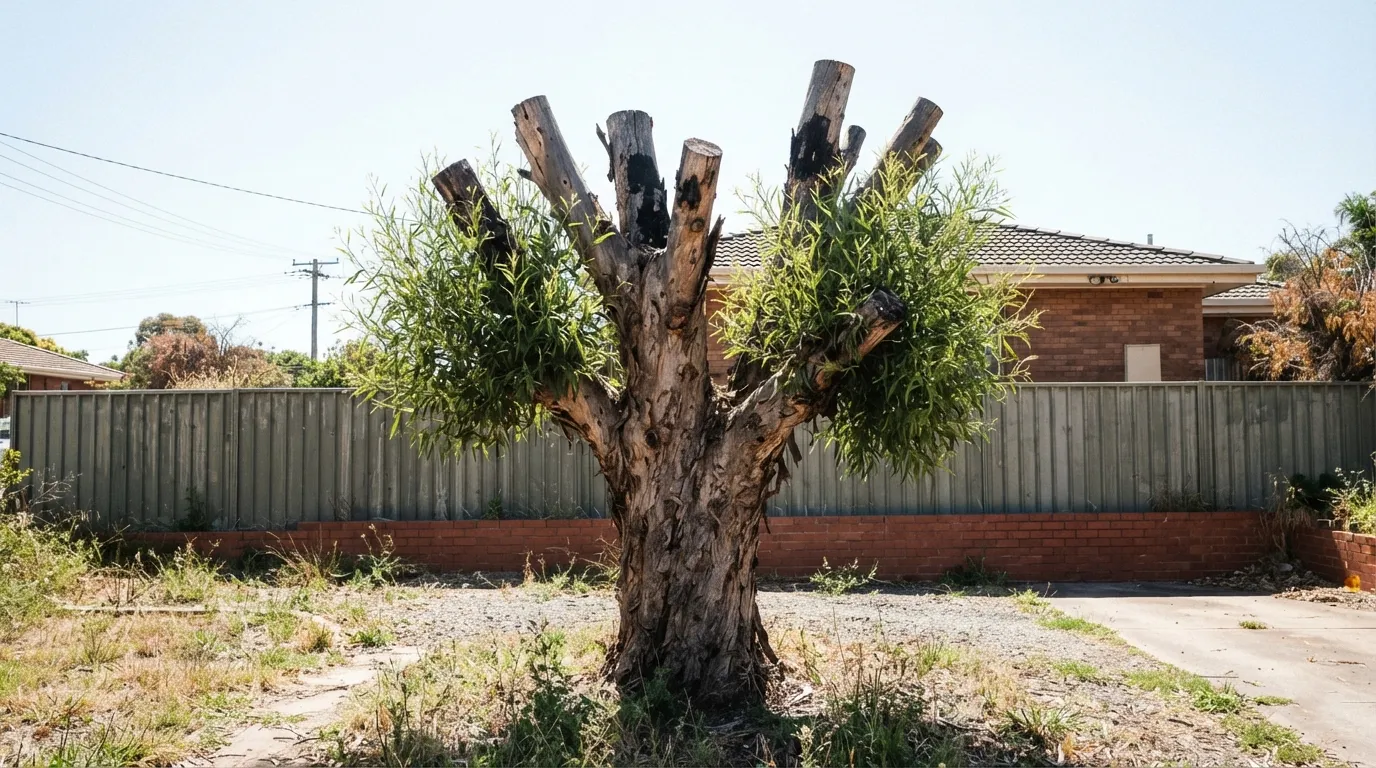
A tree lopper and an arborist can pull up in the same ute, in the same high-vis, carrying the same chainsaw. Only one of those words has a qualification behind it that you can ask to see.
"Arborist" sits on Australia's national training register. "Tree lopper" does not. It is not a qualification at all, it is the name of a cut, and it is a cut councils tell people to avoid. For the climbing and cutting, councils across Sydney and Melbourne ask for a minimum of AQF Level 3 in arboriculture. For a written report, they want AQF Level 5. This guide explains what those numbers mean and what to check before you agree to anything.
What is the difference between a tree lopper and an arborist?
The honest answer is that one word describes training and the other describes a cut.
Whitehorse City Council in Melbourne's east defines it plainly. Lopping is the removal of stems or limbs in between a node, or growing point, and it usually causes the plant to produce bushy growth behind the cut point. Pruning is different: the cut lands at the branch collar, where the limb meets the trunk, so the tree can seal it. Same saw, different place, opposite outcome.
Nothing stops a business calling itself a tree lopper. Plenty of good, properly qualified crews still do, because that is the word customers type. So the name on the ute tells you nothing. The certificate does.
If you want the detail on the practice itself, our tree lopping page covers what it does to a tree and what to ask for instead.
What is an arborist, and what does one actually do?
An arborist is someone trained to care for individual trees: assessing them, pruning them, and taking them down safely when that is the answer. Two national qualifications split the job in two.
The trade side is the Certificate III in Arboriculture, which the national training register describes as covering trade level roles including climbing arborist, EWP arborist and crane specialist, involving high risk operations either working at heights or supporting people working above ground. EWP means elevated work platform, the cherry picker.
One climbs. One writes. Plenty of people hold both, but a big firm will send you two different staff, and the quote should say which one is coming.
AQF Level 3 or Level 5: which arborist does your job need?
AQF stands for the Australian Qualifications Framework, the national scale that ranks every certificate and degree in the country. Councils use the number as shorthand. Get the number wrong and your paperwork gets knocked back.
| Level | What it is | What it covers | When you need it |
|---|---|---|---|
| AQF Level 3 | Certificate III in Arboriculture | Climbing, rigging, pruning, dismantling and removal | Almost all hands-on work. The minimum for anyone up your tree. |
| AQF Level 4 | The step above trade level | Assessing what cutting roots will do to a tree | Root pruning, which two councils below single out. |
| AQF Level 5 | Diploma of Arboriculture | Assessment, risk, and written reports councils accept | Development applications, permit evidence, disputes. |
The councils are consistent about it. Inner West Council in Sydney tells residents to check that an arborist is insured and carries AQF certification in arboriculture, to use someone with AQF Level 3 or equivalent for the work itself, to engage a consulting arborist with AQF Level 5 or equivalent for expert assessment, and to use a minimum AQF Level 4 arborist to assess root pruning.
Bayside City Council in Melbourne draws the same lines from the other side of the country, allowing pruning on private land where the work is carried out by an arborist trained to AQF Level 3 in Arboriculture, or above, or AQF Level 4 for root pruning.
If your job is roots under a path or a pipe, that Level 4 line matters, and our guide to tree root removal covers what those jobs involve. If a council has asked you for evidence, you need the Level 5 person and our guide to arborist reports explains what the report has to contain.
What qualifications should you ask to see?
Ask about the person doing the work, not the business. A company can hold every credential going and still send an untrained casual up the tree.
SafeWork NSW sets out the split in its fact sheet for people hiring tree contractors. It says to look for a Certificate II in Arboriculture to carry out the work at ground level, a Certificate III in Arboriculture to supervise tree climbing activities, and an arborist with a Diploma of Arboriculture if you need a written report.
The rule for climbing is firmer than most people expect. Under the SafeWork NSW Tree works Code of Practice, which commenced on 27 March 2026 and replaced the 1998 Amenity Tree Industry code, tree climbing "should only be carried out by competent workers with the relevant national qualification or workers undergoing training and being directly supervised by a competent person".
That same code carries the question almost nobody thinks to ask. Its rescue planning section says a crew should include at least one other member on site trained and competent in the task being completed and holding the applicable national qualification in aerial rescue. A lone climber with a mate holding the rope on the ground has no plan for the worst ten minutes of the day.
There is also a voluntary layer. Arboriculture Australia runs Registered Practising Arborist and Registered Consulting Arborist categories, which require the matching AQF qualification, a code of conduct, and 6 or 12 continuing education units a year. Not everyone good is registered. But it is a real check, and it is free to ask.
Is your arborist insured, and for how much?
This is the one that costs the most when it is missing, because the thing that goes wrong is a limb through a roof.
SafeWork NSW names three policies to look for: workers compensation for all their workers, public liability to cover your property and your neighbour's property if damage is caused or any injuries happen, and professional indemnity for damages arising from professional advice. It also tells you how to verify them: ask the contractor for a certificate of currency, or contact the issuing insurance company.
Read the neighbour's property line again. Trees fall sideways, and yours is often not the roof at risk.
How much cover is enough is not written into law, so there is no single number to demand. The clearest published benchmark comes from the industry body: Arboriculture Australia requires a Registered Consulting Arborist to hold public liability insurance to a minimum value of $5 million and professional indemnity insurance to a minimum value of $2 million. Ask for the certificate, read the figure on it, and check the dates have not lapsed.
Under-insurance is not hypothetical here. When SafeWork NSW launched a compliance campaign in this industry on 14 September 2022, it reported over 270 incidents in the industry since March 2018, workers compensation payments of over $49.5 million, and a considerable amount of potential under-insurance identified in the sector.
Why is tree lopping bad for a tree?
Because the cut lands in the wrong place, and the tree answers by growing back wrong.
A lopping cut is made mid-limb rather than at a growing point, so the plant produces bushy growth behind the cut point. You get a flush of new shoots on a stub that cannot seal. Whitehorse City Council's advice on the practice is a single sentence: lopping should never be done.
It can also cost you a permit you did not know you needed. At Whitehorse, all lopping of a protected tree requires a planning permit, while pruning a protected tree only needs one where it takes 10% or more of the canopy. The technique changes the paperwork.
Done properly, the work is measured against a written standard. Bayside City Council requires pruning on private land to conform to Australian Standard No. 4373, 2007 Pruning of Amenity Trees, with the contractor required to certify their work, including photographs of before and after work. AS 4373 is the national rulebook for where a pruning cut goes. Ask for it by number and watch how the answer changes.
Our tree pruning cost guide covers what correct pruning is worth paying for.
Who is allowed to cut a tree near powerlines?
Not your regular arborist, and definitely not you.
In Victoria the qualification is specific and separate. Energy Safe Victoria states that the minimum qualification for completing electric line clearance work is a Certificate 2 in ESI, Powerline Vegetation Control, and that only qualified and experienced arborists should be trimming and pruning trees near powerlines. That advice is a safety alert, and it followed a fatality at Malvern East on 5 February 2022, where a man trimming back a dead tree at the front of a property was most likely electrocuted after making contact with powerlines via a pole. The tree was believed to be clear of the lines before he started.
New South Wales draws a physical line instead. The Tree works Code of Practice defines a no-go zone around electric lines that no part of a person, material, crane, vehicle or item of plant may enter without written approval from the electricity supply authority, and says work on trees inside it must only be performed by authorised persons approved by that authority.
So if there is a wire anywhere near the canopy, that is the first question in the phone call, not an afterthought on the day.
What does an arborist charge in Australia?
Two published sources, two different ways of counting, and both are useful.
| What you are pricing | Figure (AUD) | Where it comes from |
|---|---|---|
| Hourly rate range | $75 - $250 | Go Tree Quotes, depending on the job |
| Average hourly rate quoted | about $182 | ServiceSeeking, 2026 quote data |
| Average day rate | about $1,423 | ServiceSeeking, 2026 quote data |
| Average standard job | about $1,315 | ServiceSeeking, 2026 quote data |
| Tree pruning | $300 - $1,800 | Go Tree Quotes |
| Arborist report, one tree | $300 - $450 | Go Tree Quotes |
The hourly figures come from ServiceSeeking's 2026 arborist pricing, drawn from quotes submitted through its platform, and the ranges from Go Tree Quotes' 2026 arborist cost guide. That second guide also gives the single most useful line about pricing in this trade: most arborists price by the job rather than by the hour, so comparing job quotes will always give you a clearer picture than comparing hourly rates.
Which is why an hourly rate is close to useless as a comparison. A slow crew at $90 an hour can cost more than a fast one at $180. For whole-tree pricing, our tree removal cost guide breaks it down by size and access.
How do you get tree removal quotes worth comparing?
Get three, and make sure all three are pricing the same job. Most quote confusion is really scope confusion.
SafeWork NSW says a written quotation should include the business ABN, contact details, detail of the works and the costs involved. If a quote is a number on the back of a card, you cannot compare it and you cannot enforce it.
Nail these down in writing before you compare prices:
- What happens to the debris. Does the chipper come, and does the timber leave with them? Two quotes that look far apart are often just answering this differently.
- Whether the stump is included. Grinding is usually a separate line, and often a separate machine and a separate day.
- How they are getting in. A backyard tree with no side access is a different job to a front yard one.
- Who handles the council paperwork. Some firms lodge for you, some hand you a form.
- What is left behind. Rake and blow, or as-is.
Tell the contractor what is underground before they quote. SafeWork NSW says to inform them of hazards such as underground tanks, underground services such as gas and electricity, or plumbing near the trees.
And settle the approval question first, because it can stop the job dead. How much it varies is easiest to see side by side. Inner West Council in Sydney requires a tree works permit for most trees, with narrow exemptions for canopy lifting to 2.5 metres above ground level and pruning deadwood that has no hollows or habitat for native fauna. Bayside City Council in Melbourne needs a local law permit where a tree is on its Significant Tree Register or has a trunk circumference over 155cm measured 1 metre above the ground. Neither of those thresholds is the rule where you live, and there is no national one, which is why SafeWork NSW's advice on this comes down to a single step: check with your local council whether you need approval to remove or prune a tree, because requirements vary.
Questions to ask an arborist before you say yes
Eight questions, none of them rude, all of them normal to a good operator:
- What qualification does the person going up the tree hold? Councils such as Inner West set AQF Level 3 as the floor for the work itself. Ask for a name, not a company brochure.
- Can I see your certificate of currency? Public liability and workers compensation. Read the amount and the expiry date.
- Is anyone on site qualified in aerial rescue? The SafeWork NSW code expects a second crew member holding that national qualification. Most quotes never mention it.
- How will you do this safely? SafeWork NSW says the contractor should be able to explain a safe method for how they intend to complete the tree work.
- Will the pruning meet AS 4373? It is the standard Bayside City Council requires private pruning to conform to. A qualified arborist will answer without hesitating.
- Are there powerlines involved, and are you approved to work near them? Ask before the day.
- Does my council need to approve this, and who is lodging it? Get the answer in the quote.
- What is your ABN? No ABN on the paperwork, no job.
The door knocker with a chainsaw
Tree work has a specific scam attached to it, and it arrives at your gate rather than in your inbox.
The NSW Government warns about travelling conmen who turn up at your door unexpectedly offering special one-off or today-only deals, ask for cash up front, and pressure you into accepting their offer. Its baseline advice for the trade is short: make sure tree work contractors are qualified, know how to do the job safely, hold the correct insurances and can provide you with a written quote.
If you have already signed something at the door, you are not stuck. Under the unsolicited consumer agreement rules the ACCC administers, you have 10 business days to cancel, starting the first business day after you sign or receive the agreement, and the seller must not take any payment during that cooling-off period. Our tree lopping page walks through the rest of those rules in detail.
The pattern to watch for is a deal that only exists today, on a tree you had not thought about this morning, from someone who wants cash. Take the name, take the ABN, and ring three qualified arborists tomorrow instead.
Frequently asked questions
Is a tree lopper the same as an arborist?
No, and the difference is not a job title. Arborist qualifications sit on the national training register: the Certificate III describes trade level roles such as climbing arborist and EWP arborist, and the Diploma describes consulting arborists who assess trees and produce reports. There is no matching qualification called tree lopper. It names a way of cutting, and Whitehorse City Council in Melbourne's east says flatly that lopping should never be done.
What is a Level 5 arborist?
Someone who holds the Diploma of Arboriculture, which the national training register describes as covering consulting arborists and tree managers who assess trees and produce reports and documentation about tree health and risk. Councils use that level as their cut-off for evidence. Inner West Council in Sydney asks for a consulting arborist with AQF Level 5 or equivalent when it wants a tree properly assessed.
Do arborists need a licence in Australia?
Do not go looking for a tree work licence card the way you would for an electrician. The official consumer advice points somewhere else: NSW Fair Trading tells you to make sure the contractor is qualified, works safely, holds the correct insurances and gives you a written quote. There is one hard qualification rule worth knowing. Energy Safe Victoria says the minimum qualification for electric line clearance work is a Certificate 2 in ESI, Powerline Vegetation Control.
How much does an arborist charge per hour?
Go Tree Quotes puts the range at $75 to $250 an hour depending on the job, and adds that most arborists price by the job rather than by the hour. ServiceSeeking's 2026 figures average about $182 an hour, roughly $1,423 a day, and around $1,315 for a standard job. Compare job quotes, not hourly rates, because a cheap hourly rate on a slow crew costs more.
What insurance should a tree company have?
SafeWork NSW lists three: workers compensation for their workers, public liability to cover your property and your neighbour's if something is damaged or someone is hurt, and professional indemnity for advice. Ask for a certificate of currency, or ring the insurer. For comparison, Arboriculture Australia requires a Registered Consulting Arborist to hold at least $5 million public liability and $2 million professional indemnity.
What should I ask an arborist before hiring them?
Ask what qualification the person climbing holds, ask to see the certificate of currency for their insurance, and ask them to explain how they intend to do the job safely, which SafeWork NSW says a contractor should be able to do. Two more that separate the good from the cheap: is there a second crew member on site holding the aerial rescue qualification, and does the quote show an ABN, the works in detail and the full cost.
All prices on this page are in Australian dollars and were compiled in August 2026. Tree permit rules, exemption thresholds and the qualifications a council will accept are set locally and change over time, so treat every council example here as an illustration of how the rules work, not as the rule where you live, and confirm the detail with your own council before you book work.
Get tree removal quotes from qualified locals
Compare qualified, insured arborists working in your postcode. Free to search, and your enquiry goes straight to the business.
Find an Arborist Near You