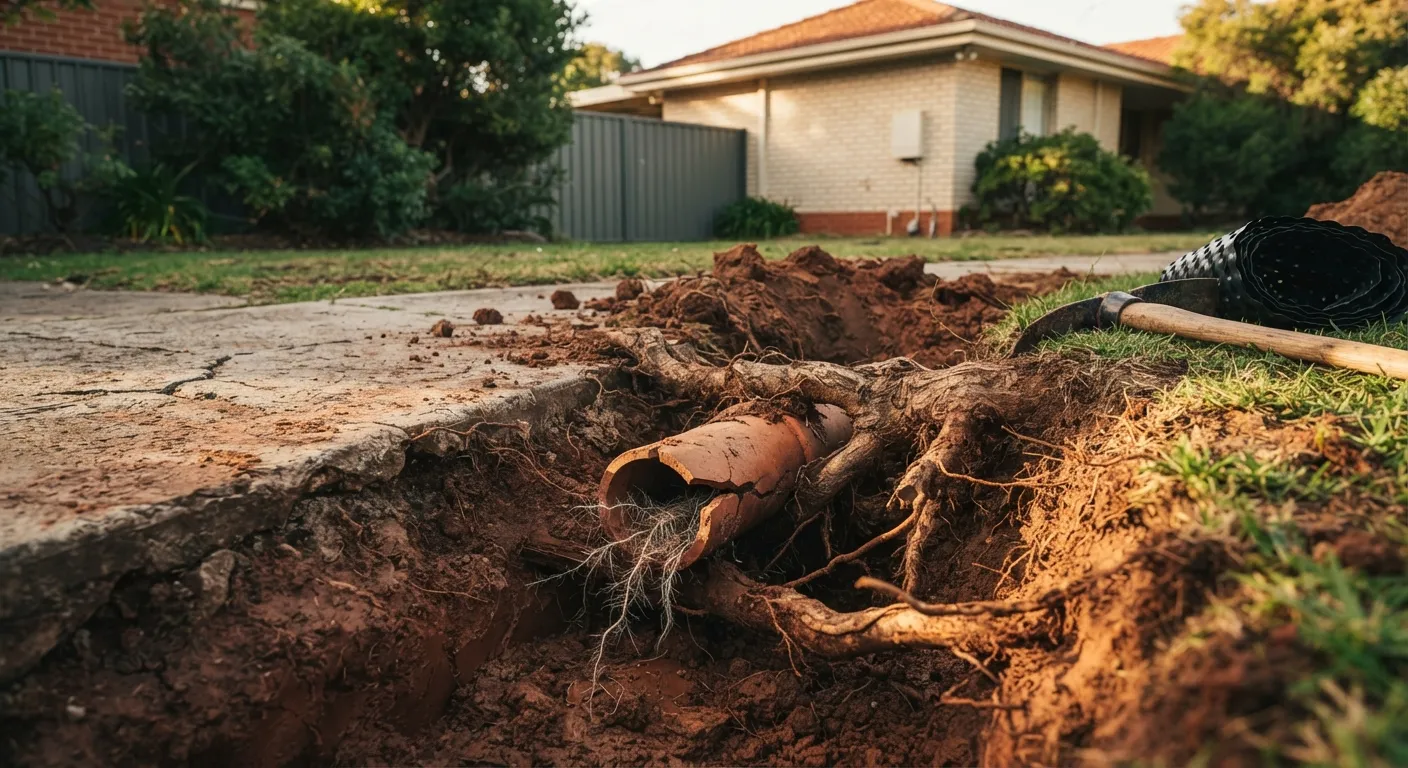
You cannot take the roots out and keep the tree. That is the sentence most people need before they ring anyone, because "tree root removal" describes four quite different jobs and only one of them is actually removal.
Roots in a drain get cut, at roughly $400 to $1,200 for root cutting in New South Wales. Roots left behind after a tree comes out get ground, at an average of $225 a stump. Roots threatening a slab or a pipe get pruned and redirected, which is arborist work. And the roots you never see get steered away by a barrier. Which of those you need depends entirely on whether the tree is staying.
Can you remove tree roots without killing the tree?
Some of them, sometimes, if the right person picks which ones. Roots do two jobs: they feed the tree, and they hold it up. The feeding roots are fine and fibrous and spread a long way. The holding roots are woody, close to the trunk, and there is no replacing them.
That inner circle has a name. Arborists call it the structural root zone, and it comes from AS 4970, the Australian standard for protecting trees on development sites, now in its 2025 edition. Councils lean on it hard. North Sydney Council only accepts reports from consultant arborists with an Australian Qualification Framework (AQF) Level 5, Diploma of Arboriculture, or equivalent, and has them monitor works at critical stages against AS 4970:2025. AQF Level 5 is the diploma-level qualification, and it is what a council wants behind a report about roots.
Cutting into the structural root zone is the mistake with the longest fuse. The tree keeps its leaves. It looks healthy for two or three summers. Then one wet, windy night it goes over, roots and all, because the anchor was cut in 2026 and nobody wrote it down.
Surface roots, the ones snaking across your lawn, are a different disappointment. Go Tree Quotes puts it plainly: those roots cannot be removed unless you plan on removing the whole tree and its stump. Raise the soil level over two or three seasons instead, or accept them.
What does tree root removal cost?
Two trades, two invoices. An arborist owns the tree, a licensed plumber owns the pipe, and the prices below reflect that split.
| Job | Typical price (AUD) | What you are buying |
|---|---|---|
| Root cutting in a drain | $400 - $1,200 | A mechanical cutter down the line, then a flush. Clears the blockage. Does not fix the crack. |
| Hydro-jetting | $250 - $600 | High pressure water through the pipe. Often bundled with the cut. |
| CCTV drain inspection | $300 - $750 | A camera showing where the roots got in. The only honest basis for the next decision. |
| Pipe relining | $200 - $400 per metre | A new liner cured inside the old pipe. No trench, no lost garden. |
| Dig up and replace a section | $2,500 - $15,000 | Excavation. What you get when the pipe has collapsed rather than cracked. |
| Stump and root grinding | $75 - $450 per stump | After the tree is gone. Grinds 20cm to 30cm down and leaves the deep roots to rot away. |
The drain figures are from The Quote Yard's 2026 blocked drain pricing for New South Wales; the grinding figures from Go Tree Quotes' 2026 stump removal guide, which averages a single stump at $225 across a $75 to $450 spread.
One line worth reading twice: grinding is not root removal. The machine takes the stump down 20cm to 30cm and the rest of the root system is simply left to decompose. If you are costing a whole tree out, our guide to tree removal costs covers the tree, and our stump removal and grinding page covers what happens to the stump afterwards.
Tree roots in pipes: whose pipe is it?
Almost always yours. That is the part people get wrong, and it is worth thousands.
Roots do not attack pipes. They find them. Sydney Water describes roots entering small cracks in wastewater pipes to seek out nutrients, then continuing to grow, taking up space and slowing drainage. An old clay joint that has shifted a few millimetres is all the invitation required.
Where the responsibility line falls is set by your water authority, and it is much closer to your house than most people assume:
- Sydney. Sydney Water says you are responsible for wastewater pipes from your property up to where they connect to the pipes that form its network. If a plumber finds the blockage was in Sydney Water's pipes, there is a claim process for reasonable out-of-pocket costs, but the plumber has to ring for a job number first.
- Melbourne. Yarra Valley Water's responsibility ends at the inspection opening, or up to 1 metre from the property boundary, whichever is less, and it states it is not responsible for maintaining internal pipes and will not reimburse internal pipe repairs.
So ring the water authority before you ring anyone else. It costs nothing and it decides who is paying. Then use a licensed plumber. In New South Wales you have no choice about that: the state requires a licence or certificate to do any plumbing, draining or gasfitting work, regardless of the cost of the work.
How do you stop roots coming back into a drain?
Cutting roots out of a pipe is a haircut. The roots grew in through a defect, the defect is still there, and the same tree is still thirsty. Most households that cut and do nothing else are back on the phone within a couple of years.
Get the camera down first. Once you can see the defect, there are only three real answers:
- Reline it. A liner cured inside the existing pipe seals the joints the roots were using. No trench across the yard, and the tree stays.
- Replace that section. The right call when the pipe is broken rather than cracked, and the expensive one.
- Deal with the tree. Sometimes the pipe is simply in the wrong place relative to a large, water-hungry species, and no amount of relining changes that arithmetic.
If anyone is putting a shovel or a machine in the ground, get the service plans first. Before You Dig Australia provides free plans for underground infrastructure at your work site, and it is a five minute job online. Go Tree Quotes notes the sting in the tail here: if a tree service damages an underground service while grinding your stump, they do not assume responsibility, because it is the owner's job to make them aware of where the services run.
Do root barriers work, and what does installation involve?
A root barrier is a sheet of tough plastic buried on its edge in a trench, so roots hit it and are steered downwards or sideways instead of into your pipe, slab or footing. It deflects rather than blocks.
Three things decide whether it earns its money. It has to sit close to what you are protecting, not ringed around the tree. It has to go deep enough that roots do not simply dive under it. And it works far better installed before there is a problem than after.
Here is the part nobody selling barrier sheeting mentions: digging that trench through an established root system is root pruning. Near a big tree, and near a protected one, that is a job for a qualified arborist rather than a hire excavator and a Saturday.
Root barriers also carry legal weight in Australia, which is unusual for a garden product. The NSW Land and Environment Court lists "pay for installation of a root control barrier" among the example orders it can make in a neighbour tree dispute, alongside orders to pay repair costs for sewer pipes, cracked walls or paths badly damaged by tree roots. A barrier is a remedy a court can hand your neighbour, not just a product you can buy.
Tree roots lifting concrete, driveways and paths
Roots do not push up out of spite. A root sitting under a slab thickens a little each year, and concrete has no give in it, so the slab cracks and tilts. By the time you can see the lift, the root is already load bearing.
Your options, cheapest first: grind the lip and live with it, replace the rigid slab with pavers or a flexible surface that can be relaid, root prune and install a barrier at the same time, or remove the tree. Slabbing straight back over the root without doing anything else buys about three years.
If the tree is on the nature strip, stop. It is the council's tree, and Northern Beaches Council states that residents cannot prune or remove council trees themselves and that penalties apply. That council also wants approval before you remove the driveway crossover on its land, and it sends its own arborist to inspect. Every council runs its own version of this, so check your council's tree claims process before a single tool comes out.
Who pays when a neighbour's or council's tree roots damage your property?
Nobody pays automatically. In every case below you are proving a case, not presenting an invoice.
A council tree. Northern Beaches Council is explicit that its ownership of the tree does not create an automatic liability in the event of a tree causing damage, and there must be demonstrated negligence. For pipe damage it asks for the service plans, a plumber's report, camera footage locating the blockage, and evidence of root ingress. Gather that before you repair anything, because a repaired pipe is a destroyed exhibit.
A neighbour's tree in NSW. The Trees (Disputes Between Neighbours) Act 2006 gives the Land and Environment Court power to order a neighbour to pay repair or replacement costs for sewer pipes, cracked walls or paths badly damaged by tree roots, and in the right case to order the tree removed, its stump ground or poisoned, and the offending roots removed. The court also recommends engaging expert arborists, builders and engineers where you need to prove what caused the damage.
A neighbour's tree in Queensland. QCAT hears tree disputes about root damage among other things, but expects you to have tried to resolve it informally first. If you own a unit, the body corporate is the owner for the purposes of the Act and has to make the application, not you.
Cutting it yourself. Queensland spells the common law out: you can exercise the right of abatement, which is your right to remove overhanging branches and roots to your boundary line, and decide whether to return the cuttings. Two limits sit on it. That page warns you to take care to comply with any applicable tree or vegetation protection orders. And the written notice process, using a Form 3, applies only where branches overhang more than 50cm and are less than 2.5m above the ground. There is no equivalent notice for roots.
Do you need council approval to cut tree roots?
Often, and it turns on your own council rather than any national rule. The trap is assuming protection stops at the trunk.
It does not. Brisbane City Council states that where vegetation is protected under its Natural Assets Local Law, the protection includes the trunk, the canopy, foliage, flowers and the root zone, and that penalties apply if you interfere with protected vegetation without a permit. That page lists trenching for plumbing or services among the activities that may affect protected vegetation, which is exactly the trench a plumber or a barrier installer digs.
Where a council does want evidence before it decides, the evidence is an arborist report from someone qualified to write it. Waverley Council in Sydney's east requires the arborist to be qualified to AQF Level 5 for the report to be accepted, and may request root mapping or identification for more complex assessments. It also expects the report to answer a specific question: can services be diverted to avoid root pruning, or a structure be relocated or rebuilt, and the tree retained. Our guide to arborist reports covers what one costs and what has to be in it.
Before you book anyone, check whether the tree is protected where you live and ask your council directly what it allows near roots. Five minutes on the phone is cheaper than a penalty and a replacement tree.
Why chemicals do not solve a root problem
Copper sulphate and foaming root killers poured down the toilet are the classic Australian shortcut, and they misunderstand the problem. They kill the roots inside the pipe. They do nothing about the crack the roots came through, so the next generation follows the same path to the same water.
They are also indiscriminate. Enough of it, often enough, and you are damaging a tree you may not be allowed to damage. Under Brisbane's Natural Assets Local Law the protection covers the root zone, and penalties apply if you interfere with protected vegetation without a permit. Poisoning does appear in the NSW Land and Environment Court's list of example orders, but as something a court directs once a tree is already coming out, not as a homeowner's first move.
If the tree really is the problem, take that decision properly: get it assessed, price the removal, and price the pipe repair against it. Our tree pruning cost guide is the cheaper end of that comparison, and tree removal is the other.
Frequently asked questions
How much does it cost to remove tree roots from a drain?
Around $400 to $1,200 to cut the roots out, on The Quote Yard's 2026 NSW figures, plus $300 to $750 if you want a camera down there to see why they got in. That is the cheap part. The repair that stops them coming back is relining at $200 to $400 a metre, or $2,500 to $15,000 if the pipe has to be dug up and replaced.
Can I cut my neighbour's tree roots on my side of the fence?
In Queensland, yes, within limits. The Queensland Government says you can exercise the common law right of abatement, which is your right to remove overhanging branches and roots to your boundary line, and you can decide whether to give the cuttings back. It also warns you to take care to comply with any applicable tree or vegetation protection orders. Cutting is not the same as being safe, though. Take out a structural root and you may own the consequences when the tree falls.
Will cutting the roots kill the tree?
It can, and worse, it can leave a tree that looks fine and is no longer stable. Roots feed the tree and hold it up. The woody roots close to the trunk do the holding, and that inner circle is what the tree protection standard AS 4970 calls the structural root zone. Cut into it and the tree may stand for years, then come over in the first real wind.
Who pays if a council street tree's roots break my pipes?
Not automatically the council. Northern Beaches Council states that its ownership of a tree does not create an automatic liability in the event of a tree causing damage. You claim, and you prove it. For a pipe, that council asks for the service plans, a plumber's report, camera footage showing where the blockage is, and evidence of root ingress. Do not repair anything before the council has seen it.
Do root barriers actually stop tree roots?
They deflect roots rather than stop them, and they work best installed early and close to the thing you are protecting. They also carry real legal weight. The NSW Land and Environment Court lists paying for the installation of a root control barrier among the orders it can make in a neighbour tree dispute, alongside paying to repair sewer pipes, cracked walls or paths damaged by tree roots.
How far from sewer pipes should I plant a tree?
Sydney Water tells its customers to avoid planting trees within 6 metres of wastewater pipes, and publishes a list of species to keep away from them, including gums, figs, willows and bamboo. Six metres is a guide, not a guarantee. A thirsty species will travel further than that to reach a leaking joint.
All prices on this page are in Australian dollars and were compiled in August 2026. Water authority boundaries, council tree protections and claim processes differ in every local government area and change over time, so treat everything here as a starting point and confirm the detail with your own council and water authority before you commit to work.
Roots where they shouldn't be?
Compare qualified, insured arborists working in your postcode. Free to search, and your enquiry goes straight to the business.
Find an Arborist Near You