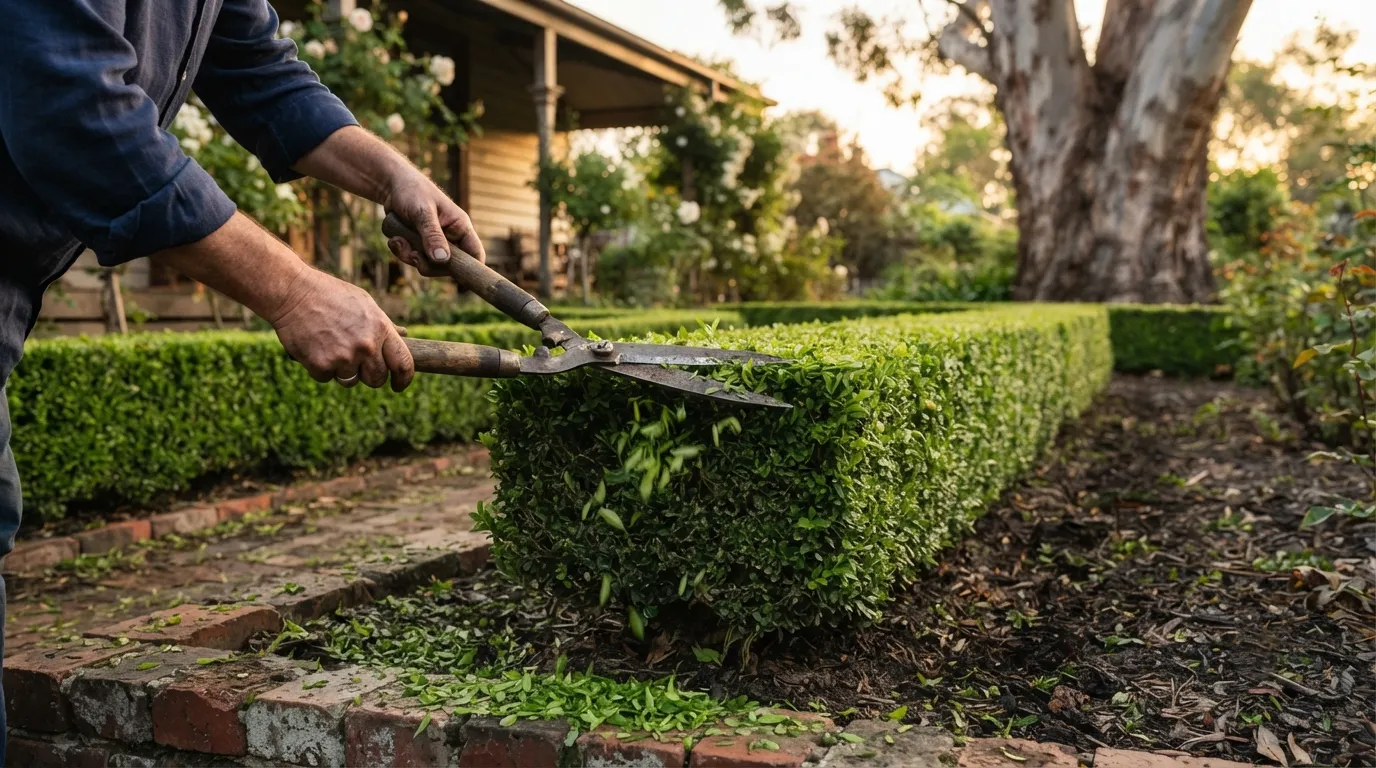
Hedge trimming means shearing a line of shrubs or small trees back to a shape, so the wall of green stays dense to the ground instead of thinning at the bottom and running away at the top. Most suburban hedges are a half-day visit two or three times a year. What surprises people is that height changes who holds the decision: clear one threshold and a neighbour can take you to court over the shade, clear a taller one and, in some shires, you need permission to cut your own. Both numbers are below. If you already know what wants doing, put the run in front of crews working your suburb with the length and rough height noted, since those two figures are what a quote is built from.
Is this an arborist's job or a gardener's?
Hedge work straddles a trade boundary, and the frankest statement of where the line sits comes from a business with every reason to blur it. A national tree-quote referral site tells readers outright to book a lawn and garden maintenance crew where they can, on the grounds that such crews are equipped for hedges of about five metres or under and are simply cheaper for the work. Above five metres it hands the job to a tree service. That is a referral site talking itself out of a referral, which makes it worth repeating.
So a waist-high buxus border does not need an arborist. What changes higher up is not the shearing but everything around it: powered blades held overhead off a ladder or platform, a drop zone on a boundary rather than in the open, and a five metre screen that has quietly stopped being shrubs and become a row of small trees. Conifers, photinia and lilly pilly all end up there, which is why so many operators sell tree and hedge trimming services as one line. Call an arborist rather than a mowing round when the hedge is over head height, when it is being reduced instead of tidied, or when it has run into a fence, a roof or a service line.
The two heights that decide who gets a say
Two numbers do two different jobs, and neither is national.
2.5 metres is where a neighbour gains a remedy. New South Wales has a statute written for hedges as such. Part 2A of the Trees (Disputes Between Neighbours) Act 2006 applies only to "groups of 2 or more trees" that "are planted (whether in the ground or otherwise) so as to form a hedge" and "rise to a height of at least 2.5 metres". Clear that and a neighbour may ask the Land and Environment Court to deal with a severe obstruction of sunlight to a window of their dwelling, or of a view from it. Orders can require the trees be kept "at a certain height, width or shape", or removed and replaced with a different species. The court cannot award compensation. Queensland reaches the same figure by another road: under the Neighbourhood Disputes (Dividing Fences and Trees) Act 2011, an order about obstruction of sunlight or a view is open only where "the tree rises at least 2.5m above the ground".
6 metres, in at least one shire, is where the council wants to be asked. Councils that publish anything hedge-specific are rare, and Wingecarribee Shire in the Southern Highlands is one. It defines a hedge as "a line of closely spaced trees / shrubs planted and trained to form a green barrier, mark the boundary of an area or provide a wind break", then routes every hedge enquiry through one question: is the hedge under six metres, or over. That threshold is that shire's own, and nowhere else is bound by it, which is exactly the point.
Victoria has neither mechanism. The state's dispute service says trees there are governed by "general property law and 'common law'", and on shade and outlook it is blunt: "there are no rules or regulations that can force a property owner not to plant big trees." A Melbourne hedge that would be actionable in Sydney is, in Victoria, a conversation.
Stack the three together and a tall boundary hedge in a shire like Wingecarribee is squeezed from both ends at once: high enough for the neighbour to act, and high enough that you cannot freely act yourself. Keeping it under the first number is the cheapest legal advice on this page.
When the hedge belongs to next door
Three states, three starting points, and none of them begins with a chainsaw.
- New South Wales. Talk first, and understand this is not merely polite. The Court "must not make an order" unless satisfied the applicant "has made a reasonable effort to reach agreement" with the owner, and notice runs at least 21 days before a hearing. It also weighs whether the hedge passed 2.5 metres during the period you have owned or occupied your place, so a screen that was already tall when you bought is a weaker case than one that grew on your watch. The Land and Environment Court notes parties commonly run these matters themselves.
- Queensland. The duty starts on the other side of the fence: a tree-keeper "is responsible for cutting and removing any branches of the tree that overhang a neighbour's land". The same Act also treats a fence as including "a hedge or similar vegetative barrier" bounding land, so in Queensland a hedge can be doing a dividing fence's legal work.
- Victoria. You hold what the state calls the right of abatement: you may cut back branches, leaves or roots crossing your boundary line, at your own cost. You are liable for damage you cause, you need the owner's consent to set foot on their land, and you should ask the council whether the thing is protected before starting.
What hedge trimming costs in Australia
No government body prices this work, and the single commercial guide that does contradicts itself inside one page: hedge trimming "starts at $95 and goes right up to $1,320" in its opening, then "ranges from $100 right up to $1,700" further down, with a stated national average of $540 and a size table whose own top figure is $1,050. Treat the headline range as noise and the table as the useful part, because height and run length are what a crew actually measures.
| Length of run | 1 m high | 2 m high | 3 m high | 5 m high | 6 m high | 8 m high |
|---|---|---|---|---|---|---|
| 4 metres | $75 | $120 | $160 | $390 | $470 | $550 |
| 8 metres | $160 | $220 | $250 | $580 | $630 | $750 |
| 12 metres | $230 | $310 | $350 | $690 | $720 | $950 |
| 14 metres | $270 | $340 | $390 | $720 | $760 | $1,050 |
Read across any row and the jump between three and five metres is the story: roughly a doubling, landing exactly where the work leaves the ground. Read down a column and length matters far less than most people expect. The same guide puts a lawn and garden crew at about $90 to $110 an hour against closer to $250 for a tree service, which is that five metre boundary expressed as a rate.
| What drives the price | Why |
|---|---|
| Height above three metres | Where ladders, platforms or a pole hedger come in, and where two people are needed instead of one. The single biggest multiplier on the job. |
| How long since the last cut | Shearing soft new growth is fast. Cutting through woody stems is slow, blunts blades and leaves a hedge that looks hacked at rather than shaped. |
| One face or three | A hedge trimmed on the street side only is a fraction of one that needs both faces and the top. A neighbour's side may need their permission. |
| Species | Fine-leaved buxus or westringia shears cleanly. Large-leaved photinia and lilly pilly tear, and conifers punish anyone cutting into old wood. |
| Access along the run | A hedge you can walk both sides of is quick. One hard against a fence, a retaining wall, a pool or a garden bed is slow and awkward. |
| Where the clippings go | Bagged and taken away is a disposal charge on top. Chipped on site can come back as mulch instead, which is the cheaper end of the same decision. |
| Anything overhead | Service lines running through or over a hedge change who is legally allowed to hold the trimmer at all. See below. |
Hedges, service lines and the boundary
Boundary hedges grow into the wires that cross the same boundary, and here the answer stops being a judgement call. Ausgrid sets minimum vegetation clearances of "0.5 to 6m depending on species, location and bushfire risk", and states that keeping those zones free of growth "is a property owner's responsibility". It then puts a flat "No." against its own question about whether an owner may do that trimming near the network: inside three metres of its powerlines, the work may only be done by accredited workers. Yours to keep clear, in other words, and not yours to cut.
Distributors are not uniform. Endeavour Energy, next door in the same state, phrases it as advice rather than prohibition, asking customers to "always maintain a three metre safety clearance away from powerlines and consider using a professional tree trimmer". Find out who runs the poles where you live before assuming either version applies.
Hiring someone who will not wreck it
A hedge is the most visible planting on most blocks and a bad cut shows for two seasons. SafeWork NSW publishes a checklist for hiring tree work contractors aimed squarely at homeowners. It is a NSW regulator writing about NSW law, but the checks themselves travel.
- Insurance, read for the neighbour clause. SafeWork describes public liability as the protection covering "yours and your neighbour's property" if damage or injury occurs during the work. On a boundary hedge that second half is not incidental, it is the whole exposure: half the job happens over the fence line, above their car, beside their glass. The document that proves such a policy is live is a certificate of currency, and the sheet's advice is to ask to see one, or to check with the insurer named on it.
- Qualifications pitched at the actual work. The same sheet puts the trade floor at a business with someone holding Certificate II in Arboriculture, which covers work carried out from the ground, and Certificate III where climbing has to be supervised. Ordinary hedge maintenance sits in the first band. A five metre screen does not.
- Something in writing. SafeWork's list is short: an ABN, contact details, a description of the works, and what it will cost. For a hedge, add three of your own, being the run length, the finished height and whether the neighbour's face is included. That last one is where most arguments start.
- Ask what they will not do. A crew that tells you a leylandii screen cannot be taken back to bare wood is worth more than one that agrees to everything.
When to trim, and how often
More often than most people manage, and starting earlier than feels necessary. ACT Government hedging advice for Canberra gardens recommends trimming the top and sides "at least 3 times per year" and "from a very young age (ideally at time of planting)", with a warning attached: let the plants hit your target height before you start cutting and "you will be left with a mass of bare branches at the bottom of your plants, and a small amount of green on the top". That is the commonest fault in Australian suburban hedges, and it is a scheduling problem rather than a plant problem. The same sheet supplies the fix, which is to trim so the bottom is wider than the top, letting sunlight reach the lower foliage.
Two species notes from that sheet are worth carrying. Many conifers grown as screens will be damaged or killed, in its words, "if they are cut back into the old, woody stems". And photinia, "most common hedge in Canberra", carries flowers in late spring that "can adversely affect those who suffer from hayfever", which is worth knowing when you set the timing in an affected household.
One timing check has nothing to do with horticulture. Dense hedges are prime nesting habitat, and in New South Wales "all native birds, reptiles, amphibians and mammals, except dingoes, are protected" under the Biodiversity Conservation Act 2016, where it "is an offence to harm, kill or remove native animals unless you hold a licence". Look along the run before the machine starts, and reschedule that section if something is sitting.
Hedge trimming near you
Which rules apply to your hedge is settled by your state and your council, so start with the city and work down to the suburb.
Frequently asked questions
How much does hedge trimming cost in Australia?
There is one Australian guide publishing hedge work by size, and it disagrees with itself, offering $95 to $1,320 in one paragraph and $100 to $1,700 in another. Its size table is the steadier part: a 2 metre high hedge running 8 metres sits at $220, while an 8 metre high run of the same length reaches $750. Hourly, it separates a lawn and garden crew at roughly $90 to $110 from a tree service at closer to $250.
When should I trim box hedges in Australia?
More often than most people do. ACT Government hedging advice for Canberra gardens says to trim the top and sides at least three times a year, starting from the moment the plants go in rather than once they have reached the height you wanted. English box, Buxus sempervirens, is described there as very slow growing to about 1.5 metres and as needing regular feeding. The other tip on that sheet matters more than timing: trim so the bottom of the hedge is wider than the top, so sunlight reaches the lower foliage.
Do I need council approval to trim a hedge?
It depends entirely on your council, and some do regulate hedges by name. Wingecarribee Shire in the NSW Southern Highlands sorts hedge enquiries by whether the hedge is under or over 6 metres tall, and defines a hedge as a line of closely spaced trees or shrubs planted and trained to form a green barrier, mark a boundary or provide a windbreak. That figure belongs to that shire. Ring the council covering your address before a tall hedge is cut.
Can I cut my neighbour's hedge where it grows over the fence?
In Victoria you have what the state's dispute service calls the right of abatement: you may cut back branches, leaves and roots crossing your boundary, at your own cost. You are liable for damage you cause, you need consent to enter their land, and the tree may still be protected by council. In Queensland the position starts from the other side, since a tree-keeper is responsible for cutting and removing branches that overhang a neighbour's land. Talk first either way.
My hedge is bare at the bottom and woody inside. Can it be brought back?
Sometimes, and the species decides. ACT Government advice warns that many conifers used as hedges can be damaged or killed if they are cut back into old, woody stems, so a leylandii screen may not forgive a hard reduction. The Australian National Botanic Gardens describes a basal prune, a severe cut to ground level, as a rejuvenation method that works on only a small percentage of plants. Get someone to look at it before booking the cut, because on some hedges reduction is a replanting decision in disguise.
The price table above belongs to a single commercial cost guide, was read in August 2026, and is reproduced because it is the only Australian source publishing hedge work by height and length at all. It is one operator's estimate, not a market rate, and the guide's own headline figures disagree with it. Its table carries no axis labels; height and length are assigned here from the range the same guide states in its own text, being 1 m high by 2 m long at the small end up to 10 m high. Legal thresholds quoted here come from the instruments and councils named beside them, bind only the state or shire publishing them, and change without notice. Where the two differ, the publishing body's own page governs and this page is merely a signpost to it. Arborists are listed here; the cutting is theirs rather than ours.
Get the hedge back under control
Measure the run, note the finished height you want, and let crews covering your postcode quote off the same two numbers.
Find a Hedge Trimming Arborist Near You