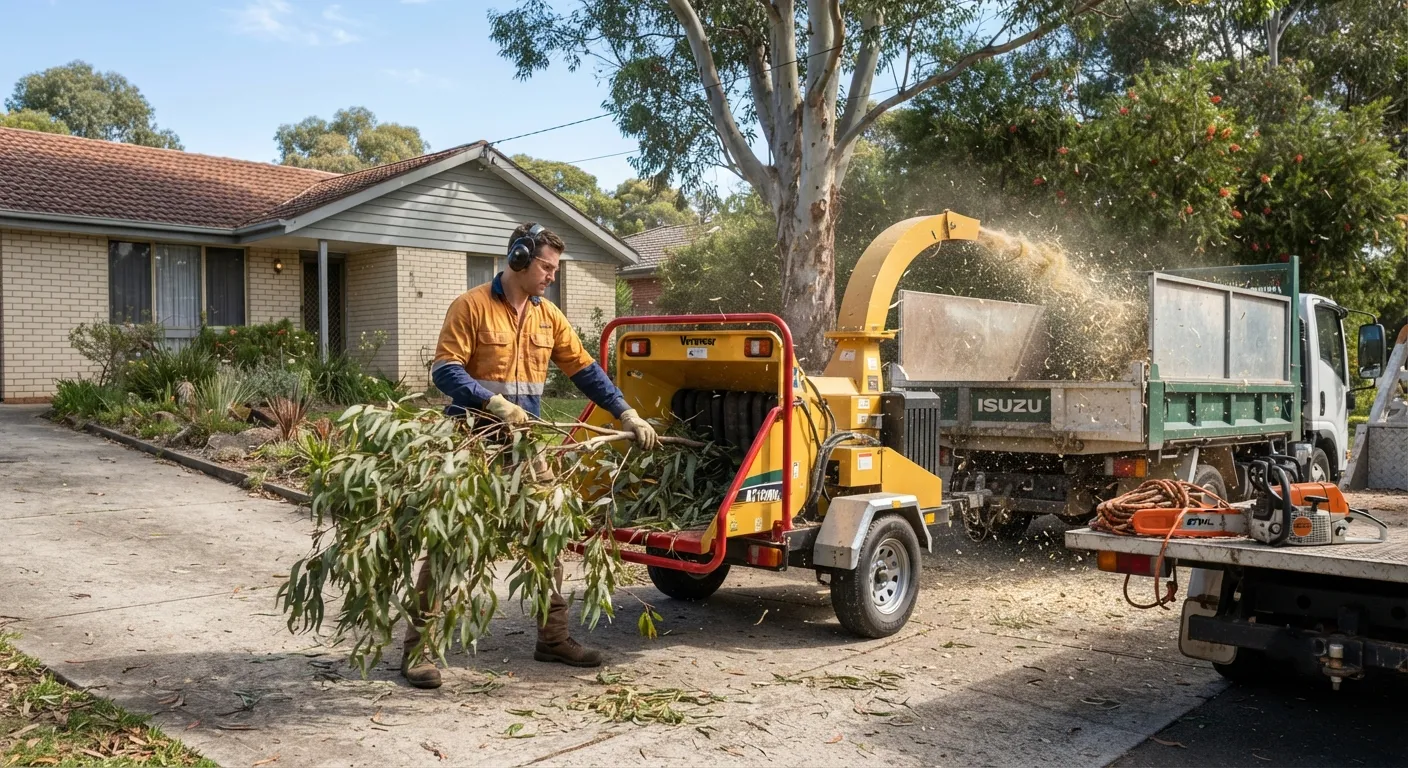
Mulching is what happens to the branches after the cutting stops. Limbs and foliage go through a chipper, come out as wood chip, and then either get raked over your garden beds or loaded out and weighed in at a waste facility. The chipper is on site regardless, because feeding a limb through a machine beats lifting it whole onto a truck, so the material is already sitting on your driveway and the only live question is where it finishes up. Leaving it with you is usually the cheapest answer for you and the quickest for them. Raise it while the job is being quoted rather than on the day, and to get a number worth comparing, send the job to crews working your postcode and let them see the size of the pile.
What mulching services actually cover
The word covers four fairly different jobs, and the quotes look nothing alike.
- Chipping during tree work. The default. Branches from a removal or a pruning job go straight through the chipper and the crew asks whether you want the chip left behind.
- Supply and spread. Mulch delivered by the cubic metre and raked out across beds, with no tree work attached. This is the one people mean by a garden mulching service, and it is as much a landscaping job as an arboricultural one.
- Green waste collection. A crew comes for a pile that already exists, usually one you made yourself, and takes it away.
- Machine mulching across a block. Scrub and regrowth mulched where it stands on acreage, which belongs with land clearing rather than with garden work and is priced by machine hours.
Some material never becomes mulch at all. Palm fronds and trunks are the standard example, and the trade is blunt about it: palm material cannot be mulched and travels out as general waste at general waste rates, which is one reason a palm removal quote reads high for the size of the plant.
Green waste removal, or mulching in place?
This is the decision the whole price hangs on, and councils have already published the arithmetic. South Gippsland Shire, to take one that sets out its schedule plainly, charges its residents by the load at the gate on rates effective from 1 July 2026.
| What you turn up with | Greenwaste charge |
|---|---|
| 240 L bin | $9.00 |
| Car boot or station wagon | $9.00 |
| Single-axle 6x4 trailer, level load | $15.00 |
| Single-axle 6x4 trailer, heaped | $27.00 |
| Single-axle 6x4 trailer, caged | $53.00 |
| Tandem trailer, heaped | $53.00 |
| Tandem trailer, caged | $107.00 |
Two things in that schedule matter more than the dollars. The first is the exclusion list. Greenwaste rates do not cover branches over 300 mm in diameter, tree stumps, coated timber, or a named set of weeds including blackberry, ragwort, gorse, hawthorn, pampas grass and agapanthus, and they do not cover species that physically cannot be mulched, which the council lists as bamboo, palm fronds, cordylines, yuccas and their relations. All of that attracts general waste charges instead. So a trailer of prunings and a trailer of agapanthus are the same volume and a different bill, and a crew that quoted you the cheap rate for the wrong material has quoted you the wrong number.
The second is that the same council hands the finished product back for nothing. Residents can collect mulch for their gardens free of charge at the transfer stations, at any time of year, and there is a greenwaste amnesty running from the Saturday before Melbourne Cup through to the end of December when disposal is free too. Plenty of councils run a version of this. It is worth ten minutes on your own council's waste page before you pay anyone to bring mulch to you, because the material that came off someone else's tree last month is often sitting in a heap waiting for a shovel.
What do mulching services cost?
Mulching is rarely quoted as its own line. It is folded into the tree job, which makes the honest way to think about the cost not "what does mulching cost" but "what does the chip decision add or subtract". Here is what moves it.
| What drives the price | What it does to the quote |
|---|---|
| Whether the chip stays | The single biggest lever. Chip left on site skips the trip and the gate fee entirely. Chip taken away is a truck movement plus a disposal charge, and it is charged on to you one way or another. |
| What the material is | Clean prunings run at greenwaste rates. Palm, bamboo, cordyline and the listed weeds do not, and go out as general waste at a higher rate. Stumps and anything over about 300 mm through are usually out of scope again. |
| Access for the chipper | Whether the truck can park near the work decides how far every branch is dragged by hand. The trade's own guidance is that a chipper truck close to the base keeps a job moving, and a narrow side gate multiplies the labour. |
| Spreading, not just dumping | Tipping a load on the driveway and raking chip evenly through established beds are different amounts of work. Say which one you are buying. |
| Volume | Chip is bulky and light. A mature gum can produce more of it than a suburban garden can absorb, and the surplus still has to go somewhere. |
| Contamination | Wire, treated pine, plastic ties or building offcuts through a load change what it legally is, and reclassify the whole trailer at the weighbridge. |
Fresh wood chip is not the same product as bagged mulch
This is the part almost nobody is told, and there is an Australian Standard sitting behind it. AS 4454-2012, Composts, soil conditioners and mulches, specifies physical, chemical, biological and labelling requirements for the product, including the minimum a product has to meet before it can be labelled composted or pasteurised. It is a voluntary standard rather than a law, which makes its scope more interesting rather than less: shredded garden organics that have not been through a pasteurisation or composting procedure are specifically excluded from the standard, and it says why in plain words, because they have a high probability of containing plant propagules and pathogens. Raw mulch can come back inside, but only where it has been verified free of propagules and pathogens.
In practice that means the chip coming out of the machine on your driveway is a genuinely different product from a bag marked composted or pasteurised, and not because one is better made. That label means the material has been through a heat or composting process aimed squarely at the seed and the pathogens in it. Yours has not been through anything. Whether that matters depends entirely on what went into the chipper. Prunings off a healthy gum are fine, and spreading them is the best thing that can happen to that material. A hedge full of seeding weeds, or a tree that came down because something was killing it, is a different proposition, and "we will just spread it for you" is the moment to ask what was in the load.
How deep should mulch go, and how close to the trunk?
First, why bother. Western Australia's state water utility is unusually specific about the payoff, putting a generous layer of waterwise mulch at up to 20 per cent of the water used in a garden, on top of reducing evaporation loss, improving the soil and holding weeds down. Its advice on grade lines up with what comes out of a chipper: choose a chunky coarse mulch, which beats soft fine material like straw and lucerne for water saving, and put down 5 to 10 cm of it.
Depth after that follows particle size rather than being one number. Queensland's waterwise gardening guidance puts the mechanism plainly: coarse material such as pine bark needs more than 5 cm to work, while fine material should go on at around 2 cm, because it is more prone to compaction and has to be loosened regularly to keep water moving through it. Arborist chip is coarse, so it belongs at the deeper end of both sets of numbers.
Then the rule that saves plants: keep the mulch about 6 to 7 cm clear of stems, or they rot. Piling chip up against a trunk in a neat volcano is the most common mulching mistake in Australian gardens and it is done with the best intentions every weekend. The Queensland guidance flags one more thing worth knowing before you spread a thick layer of fresh chip through a vegetable bed: as organic mulch breaks down it draws nitrogen out of the soil, and yellowing lower leaves are the sign you need to put some back.
Mulch and bushfire: what the research says
If your place is anywhere near bush, this changes what you should accept. CSIRO's bushfire best practice guide is direct about it in its section on mulches: mulch can be a significant fire hazard if it is used and managed badly. Its advice is to avoid very fine or light mulches such as shredded pine bark, pine needles and poplar woodchips, and it gives a threshold you can hold a handful of chip against, that anything finer than about half a centimetre across should be avoided, because fine material is highly flammable and gives fire a ready path along the ground.
Placement matters as much as grade. CSIRO says not to store combustible mulch against the house or near other combustible structures, and singles out the spots people actually use, under and around windows, doors and subfloors. Where a mulched bed is unavoidable it recommends breaking the area up with non-combustible elements such as paths and open spaces so it cannot run as one continuous fuel bed, and using stone or concrete edging rather than timber. Pebbles, shells and gravel will not burn and are, in CSIRO's words, your best option. None of that makes chip the wrong answer for the back of a block. It makes it the wrong answer under a bedroom window in a fire-prone area, which is a conversation to have with the crew before they start raking.
Where mulch is not allowed to travel
Chip moves pests, and in one Australian city that has become a legal restriction on the machine itself. The whole Perth metropolitan area sits inside the polyphagous shot-hole borer Quarantine Area, and the notice reaches the mulching trade specifically. Residents in Zone A cannot move untreated or unseasoned wood outside Zone A unless it has been chipped to pieces 2.5 cm or less, cannot move plant material, living plants included, thicker than 2 cm in diameter outside Zone A, and must make sure any machinery used to handle green waste is cleaned before it leaves. Zone B carries the same obligations measured against the boundary of the Quarantine Area rather than Zone A, which is a different line on the map and worth checking rather than assuming. Grass and lawn clippings are exempt, because the beetle does not live in them.
The definition doing the work names this trade outright. Wood machinery, under the notice, means any vehicle, equipment or mechanical apparatus of any kind used in relation to arboriculture, wood mulching, wood chipping or the handling of any other wood. A chipper is that machine. Anyone who cannot meet the conditions has to obtain a permit from the department before moving restricted material. If you are in Perth, asking a crew how they handle the quarantine is not being difficult, it is asking whether they know the rules they work under.
Choosing someone to mulch for you
For most tree services the questions are about the person on the rope. For this one they are mostly about the material and the machine, so ask in that order.
- What is actually in this chip? A crew that can tell you what came down, whether it was healthy and whether anything seeding went through the machine is a crew that understands the standard their product sits outside. One that shrugs is offering you a mystery load for your garden beds.
- Where was the chipper yesterday? A machine that handled diseased or quarantined material and was not cleaned down carries the problem to you. In Perth that clean-down is a legal requirement rather than good manners, and it is a reasonable question anywhere.
- Who is covered if the machine throws something? A chipper putting a piece of timber through a window or a neighbour's car is a plant-and-machinery claim, not a climbing accident, and the two do not automatically sit under the same policy. Registration with Arboriculture Australia sets a floor: $5 million of liability cover for its practising grades, plus $2 million of indemnity where the arborist also gives advice. Notice who that floor reaches. It binds arborists and no one else, so a supply-and-spread landscaping business sits outside the scheme altogether and you are left reading the certificate yourself.
- Is spreading in the price, or is tipping? The gap between those two is hours of labour, and it is the most common cause of a mulching job feeling like it was not finished.
Where the pile came from a stump rather than a canopy, stump removal covers what happens to grindings, which are a different material again. If you are trying to work out the cost of the tree job the mulch is attached to, what it costs to remove a tree in Australia has the size bands.
Find mulching services near you
Chipping travels with tree work, so the crews are wherever the trees are, and a business that prunes in your suburb already owns a chipper. Choose a city below, or search by postcode and ask two or three of them what they would do with the pile.
Frequently asked questions
How much do mulching services cost in Australia?
It is usually not a separate price. Chipping is built into the tree job, and what changes the total is whether the chip leaves with the crew. If it does, you are paying for a truck movement and a gate fee, and gate fees are published: South Gippsland Shire charges $15 for a level 6x4 trailer of greenwaste, $27 heaped and $107 for a caged tandem load. If the chip stays on your garden beds, that whole line disappears. Ask for the quote both ways.
Can I keep the wood chip from my own tree?
Usually yes, and most crews are glad to leave it because it saves them the trip. Say so before the work starts, and be realistic about volume, since one mature tree can produce more chip than a suburban garden has anywhere to put. Decide where it is going to be dropped and whether spreading it is included, or you will end up with a mountain on the driveway and a rake.
Is fresh wood chip as good as bagged mulch?
For a healthy tree, yes, and it is free. But they are not the same product. AS 4454-2012, the Australian Standard for composts, soil conditioners and mulches, specifically excludes shredded garden organics that have not been pasteurised or composted, on the basis that they have a high probability of containing plant propagules and pathogens. A bag marked composted or pasteurised has been through a process aimed at the seed and the pathogens in it. Chip off your own tree has not, so what went through the machine is the thing that matters.
How deep should mulch be, and how close to the trunk?
Depth depends on the particle size. Western Australia's water utility recommends 5 to 10 cm of chunky coarse mulch, and Queensland's waterwise gardening guidance calls for more than 5 cm of coarse material such as pine bark, dropping to around 2 cm where the mulch is fine, because fine mulch is more prone to compaction and needs loosening to keep water moving through it. Arborist chip is coarse and goes on the deeper end. Then keep it roughly 6 to 7 cm clear of stems and trunks, or they rot. Never pile it against the trunk.
Is mulch a fire risk?
It can be, and CSIRO's bushfire best practice guide treats it as a real hazard rather than a small one. It advises against very fine or light mulches, gives about half a centimetre as the size below which material becomes highly flammable, and says not to store combustible mulch against the house or near windows, doors and subfloors. Pebbles, shells and gravel do not burn and are the safer choice close to a building in a fire-prone area.
Does mulch attract termites?
No Australian government source found for this page makes that link, which is worth saying plainly, because the claim is everywhere. Victoria's health department page on termites does not mention mulch at all. What it does document is that Coptotermes build nests in trees, preferring eucalypts, and in stumps, and that they travel at least 50 metres underground to reach food. On the evidence, the leftover stump is the documented risk, not the chip on the garden bed.
Every dollar figure here is Australian, was read off the council or trade source that publishes it in August 2026, and belongs to one operator rather than to the country. Waste gate fees in particular are reset on each council's own cycle, so treat these as an illustration of how the charging works and look up your own before you budget. Standards, quarantine notices and council schedules all change without telling anyone, which makes the body that publishes them the authority rather than this page. We are a directory. The mulching itself is quoted and carried out by the businesses you contact through us.
Got a pile that needs dealing with?
Say what came down, how much of it there is and whether you want the chip left behind. Local crews can price it from there.
Find a Mulching Service Near You