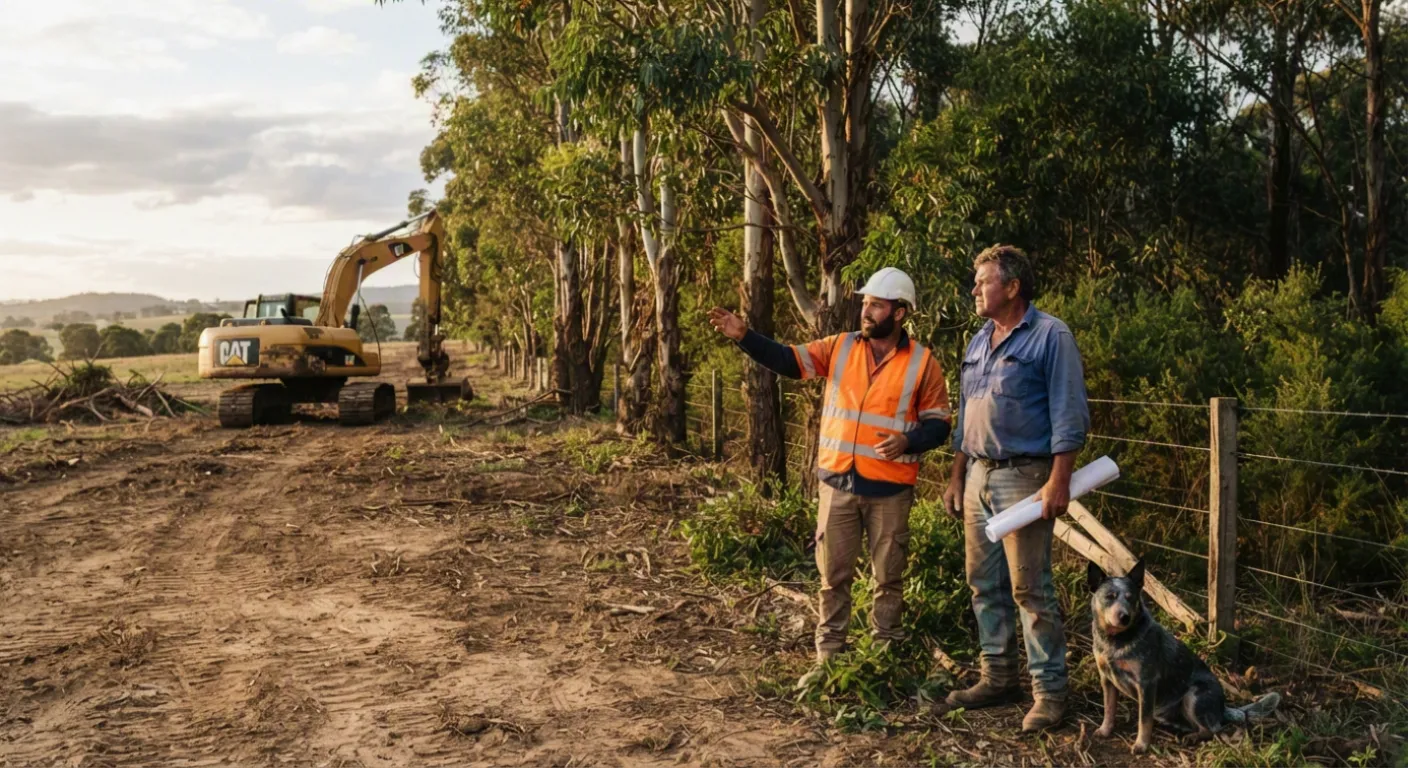
Taking a block back to workable ground sits somewhere between arboriculture and earthmoving, which is why two quotes on the same paddock can look like they were written for different jobs. Before any of that, one question decides whether the work is legal at all: across most of Australia, clearing native vegetation needs approval from a state body rather than from your council, and that approval attaches to your land rather than to the contractor who drives in. So the useful order is to establish what your block is mapped as, then put the site in front of operators who work in your area and have each of them walk it.
What land clearing actually covers
One price usually bundles work that would be quoted separately anywhere else.
- Standing trees. Four gums beside a house are still tree removal and get priced that way, tree by tree. A stand of them across two hectares is clearing.
- Stumps. Sometimes ground out, sometimes pushed over and raked into a heap, sometimes left in the ground because nothing is going on top of them. Stump removal and grinding explains how that half is priced.
- Scrub, regrowth and grass, either slashed or mulched where it stands.
- The debris. Chipped on site, stockpiled, burnt where the local rules allow it, or weighed in at a waste facility.
- Access work, which is the invisible line item: a track in, a gate widened, a fence line cut so the machine can get to the back corner.
- The finish. Some jobs stop at slashed. Others go to stump-free. Others go to graded and ready for a slab.
That last one causes more quote-to-quote variation than anything else on this page. Decide it before anyone walks the block, and put it in writing.
Do you need approval to clear land in Australia?
Start from the assumption that you do, and that the answer is not at the council counter. Each state runs its own native vegetation system under its own Act, and the tests are not comparable with each other.
| Where the block is | Who approves it, and on what test |
|---|---|
| New South Wales | Rural-zoned land runs under the Local Land Services Act 2013. Routine work can be an allowable activity needing no approval, within published limits. Anything beyond that goes to Local Land Services for a certificate or approval. |
| Queensland | The vegetation management framework sorts every job into an assessment category: exempt, an accepted development clearing code, an area management plan, or a full development approval. Codes require you to notify the department before you start. Request the free property report and vegetation map first. |
| Victoria | A planning permit is required to remove, destroy or lop native vegetation unless an exemption applies. Applications go to the responsible authority, which is usually the council, and the local planning scheme can ask for more on top. |
| South Australia | Native vegetation is protected across the state except most of metropolitan Adelaide. Two pathways: clearance under the Native Vegetation Regulations 2017, with no application fee but requiring Native Vegetation Council consent and an offset, or clearance assessed under the Native Vegetation Act 1991, which carries a fee. |
| Western Australia | A clearing permit is required unless you have an exemption or the referral process determined you did not need one. Some exemptions stop applying inside declared environmentally sensitive areas, so check the mapping rather than the rule. |
| Northern Territory | Clearing native vegetation on freehold unzoned land requires a permit, which is applied for and then managed through the Territory's own process. Pastoral land is dealt with separately again. |
Two further layers catch people. Councils can regulate on top of the state scheme, which is why New South Wales warns landholders that even where an activity is allowable, approval may still be needed from the local council or from another authority under another Act. And Queensland's own guidance points upward to the Commonwealth: approval under the Environment Protection and Biodiversity Conservation Act 1999 can be required where clearing would significantly affect matters of national environmental significance, and separate rules cover protected plants under the Nature Conservation Act 1992 and mapped koala habitat in the South East Queensland Regional Plan area.
How much can you clear without approval?
Less than almost anyone assumes. New South Wales is the state that publishes hard distances, and they are worth reading even if your block is elsewhere, because they show how narrow "routine" clearing really is. On rural-zoned land, clearing to build, use or maintain rural infrastructure needs no approval under the Local Land Services Act 2013, provided it supports genuine agricultural use and does not need development consent under the Environmental Planning and Assessment Act 1979. Then the tape measure comes out.
| Zone or land type | Maximum clearing distance |
|---|---|
| Western zone | 40 m |
| Central zone | 30 m |
| Coastal zone | 15 m |
| Small holdings, any zone | 12 m |
| Temporary fences, any zone | 12 m |
| Vulnerable and sensitive regulated land | 6 m |
A small holding means under 40 hectares in the Western Division and under 10 hectares elsewhere in the state. The detail that surprises people is the sting on the end: those maximums apply even where part of the clearing has already been done by an adjoining landholder, so a neighbour who has cut their side of the fence has spent your allowance rather than added to it. Firebreaks sit outside the table. In the western zone you may clear to 100 metres where the vegetation is predominantly a mallee species, which buys you nothing on the coast or in the central zone, and clearing for fire protection is administered through the Rural Fire Services Act 1997 instead.
What does land clearing cost?
No honest national figure exists, and it is worth explaining that rather than inventing one. The most-cited Australian tree cost guide publishes bands for removals, a table for stumps and another for palms, and nothing whatsoever for clearing a block. Cost per acre, the phrase people type in, is close to meaningless anyway: one acre is a morning of slashing and the next one is three days of felling, depending entirely on what is standing on it. What you can do is price the parts.
| What drives the price | What it does to the quote |
|---|---|
| Number and size of the trees | The dominant line on a treed block. That same cost guide's removal bands are the closest thing to a yardstick: $500 to $1,500 for a 5 m to 6 m tree, $3,000 to $7,000 at 9 m to 20 m, and up toward $22,000 above that. A block with ten mature gums is not a clearing job with trees in it; it is ten removals with clearing around them. |
| Where the waste goes | Charged by the tonne at the weighbridge, and green waste is heavy. Chipping and spreading on site can take this line close to zero. Carting to a facility can make it the second-biggest number on the page. |
| Access and ground | Slope, wet ground, a single narrow gate, a creek crossing, or overhead lines that force smaller gear. This is why a walked quote beats a phone quote by a wide margin. |
| The finish you are buying | Slashed, mulched, stump-free or graded. Each step up adds machine hours and, for stumps, a second piece of equipment. |
| Approvals and offsets | Application fees, the mapping or assessment work behind them, and in South Australia an offset requirement attached to the clearance itself. |
| Weeds on the block | An infested site adds clean-down time before the machine can leave, and can rule out chipping and spreading the material where it fell. That is hours on the job rather than tip fees. |
Anyone who prices your block over the phone without asking about the gate width, the slope and where the waste is going has not priced it.
What happens to everything that comes down
On a lot of blocks the disposal costs more than the cutting, and it is the half of the quote nobody asks about. There are three routes. Chip it and spread the mulch back over the site, which skips the weighbridge entirely and puts organic matter back into ground that has just been stripped. Stockpile it, which is free today and someone else's problem later. Or cart it out and pay by the tonne.
Those tonnage rates are public and they are not small. The City of Newcastle charges $187 a tonne for garden organics at its Summerhill centre, with a $26 minimum charge, on rates that run until 30 September 2026. The same load becomes mixed non-putrescible waste at $451 a tonne once fencing wire, treated timber or building rubble is through it. That gap is why a tidy operator separates on site and a careless one does not, and why "waste removal included" is a line worth reading twice.
Mulching the material where it falls has a catch worth naming. Chipping a weed infestation and spreading it across clean ground moves the problem rather than solving it, so ask what is being mulched before you agree to have it spread.
What has to happen before a machine starts
Three checks, none of which take long, all of which are expensive to skip.
- Find the services. Before You Dig Australia takes a free enquiry and returns the plans for underground assets. Its own advice is to settle who is lodging it before any contractor starts excavation work, and to remember that pipes and cables often run just outside the boundary under the footpath, nature strip or fence line. It also puts landholders on notice that the owner of a cable or a main can come after them for the repair bill, which is the clause that turns a cheap job dear.
- Look up. The same organisation runs a Look Up and Live tool covering overhead powerlines, and it explicitly extends to farms and rural properties. A mulching head on a raised boom and a rural distribution line are a bad combination.
- Ask where the machine was yesterday. Vehicles and machinery carry weed seed and reproductive material between properties. The New South Wales advice is blunt about it, telling operators to come clean, leave clean, to set up temporary clean-down areas on the property, and to use the public washdown facilities that exist in many local government areas. An unwashed machine is how a clean paddock stops being one.
Choosing a land clearing contractor
The thing to understand about this service, and it separates it from every other job on this site, is that the enforcement risk sits with the land rather than with the operator. Queensland monitors clearing from orbit, using satellite imagery through the Statewide Landcover and Trees Study and an Early Detection System to identify changes in vegetation cover, and properties can be audited on the strength of that imagery alone. Clearing the department cannot account for may be investigated by authorised officers and can end in enforcement action. The department's advice to landholders is worth following anywhere in the country: keep a diary of clearing operations, take before-and-after photographs from recorded locations, and document your instructions to operators and supervise any clearing carried out by contractors. If a machine takes out more than the approval covered, the department comes to the person who owns the dirt.
So the questions are less about the machine and more about the paperwork behind it.
- Who is establishing what may be cleared? A quote that arrives without anyone mentioning your land category or a property report is a quote for work that has not been checked.
- Is there an arborist on the job, or only an operator? Trees that have to be climbed, dismantled or dropped near buildings are arborist work, and Arboriculture Australia registers practising arborists at Certificate III level and consulting arborists at Diploma level. Plenty of clearing crews carry both tickets. Plenty do not, and you want to know which one is turning up.
- Whose name is on the certificate of currency? A mixed crew makes this harder than it sounds. A registered arborist has already had to satisfy Arboriculture Australia, whose entry floor is $5 million, lifting by another $2 million of indemnity cover for the grades that give advice. An earthmoving operator sits outside that scheme, so on a clearing job the tickets and the policy can belong to two different businesses. Establish which one covers the machine. Brisbane City Council sets a higher bar again, $20 million for an arborist who writes a report on vegetation it protects.
- Who lodges the BYDA enquiry, and who wears a strike? Settle it in writing before the first machine unloads.
If the block needs a document to support an application, arborist reports covers what councils and assessing bodies actually ask for, and tree pruning is the cheaper answer where the problem is a canopy rather than a paddock.
Find land clearing services near you
Clearing demand follows the growth corridors and the acreage belts rather than the inner suburbs, so the crews are concentrated on the urban fringe and in the hinterland behind the coastal cities. Pick a city below, or search the directory by postcode and put the block in front of whoever is closest to it.
Frequently asked questions
How much does land clearing cost in Australia?
There is no reliable national figure, and any site quoting one per acre is guessing. The number is assembled from the trees, which run from about $500 for a small one up to $22,000 for something enormous, plus disposal charged by the tonne at the weighbridge, plus the machine time that the access and the ground conditions force on the crew. Two blocks of the same size in the same shire can differ by a factor of ten. Have the site walked and get the quote itemised.
Do I need a permit to clear my own land?
In most of Australia, yes, and the approval usually comes from a state body rather than the council. Victoria requires a planning permit to remove, destroy or lop native vegetation unless an exemption applies. South Australia protects native vegetation everywhere except most of metropolitan Adelaide. Western Australia requires a clearing permit unless you hold an exemption. Queensland sorts every activity into an assessment category, and New South Wales runs rural land under its own land management framework. Owning the land is not the same as being allowed to clear it.
How much land can I clear without approval?
Less than most people assume, and New South Wales is the state that publishes the actual distances. Clearing for rural infrastructure on rural-zoned land is capped at 40 metres in the western zone, 30 metres in the central zone and 15 metres on the coast, dropping to 12 metres on small holdings and 6 metres on vulnerable and sensitive regulated land. Those caps hold even where a neighbour has already cleared part of the same line.
What is the difference between land clearing and tree removal?
Scale, machinery and who approves it. Tree removal is priced one tree at a time and turns on climbing, rigging and what sits underneath. Clearing is priced by the block, runs on tracked machines, and brings in native vegetation law that a single garden tree rarely touches. Plenty of jobs are both. A house block with four gums along the boundary and scrub behind them is a tree removal job with a clearing job stapled to it, and it is worth asking for the two halves separately.
What happens to the trees and green waste after clearing?
Chipped and spread on site, stockpiled, or carted to a waste facility and weighed in. Disposal is charged by the tonne, so it is a real number rather than a rounding error. The City of Newcastle charges $187 a tonne for garden organics at Summerhill and $451 a tonne for mixed non-putrescible waste, which is what a clean load turns into once wire, treated timber or building rubble gets mixed through it. Ask how the waste is leaving before you compare two quotes.
Who is liable if a contractor clears more than the approval allowed?
The landholder carries it, which is why the paperwork matters. Queensland monitors clearing with satellite imagery and can audit a property on the strength of that imagery alone, and its own advice to landholders is to keep a diary of operations, take before-and-after photographs, document the instructions given to operators and supervise clearing carried out by contractors. Do that on any job, in any state. A verbal brief to a bloke on a dozer is not a record.
Dollar figures on this page are Australian and were read from the authority that publishes them during August 2026. Waste facility charges and permit fees are reset by their owners on their own calendars, so confirm the current rate before you budget against it. Regulatory material here was taken from each state agency's own website the same week and can be amended without notice, which makes the body that administers your block the final word rather than this page. We list contractors and arborists and pass enquiries to them. No work described here is priced, booked or performed by us.
Got a block that needs clearing?
Tell us the size, the access and what you want it left like. Contractors near you can price it properly from there.
Find a Land Clearing Contractor Near You