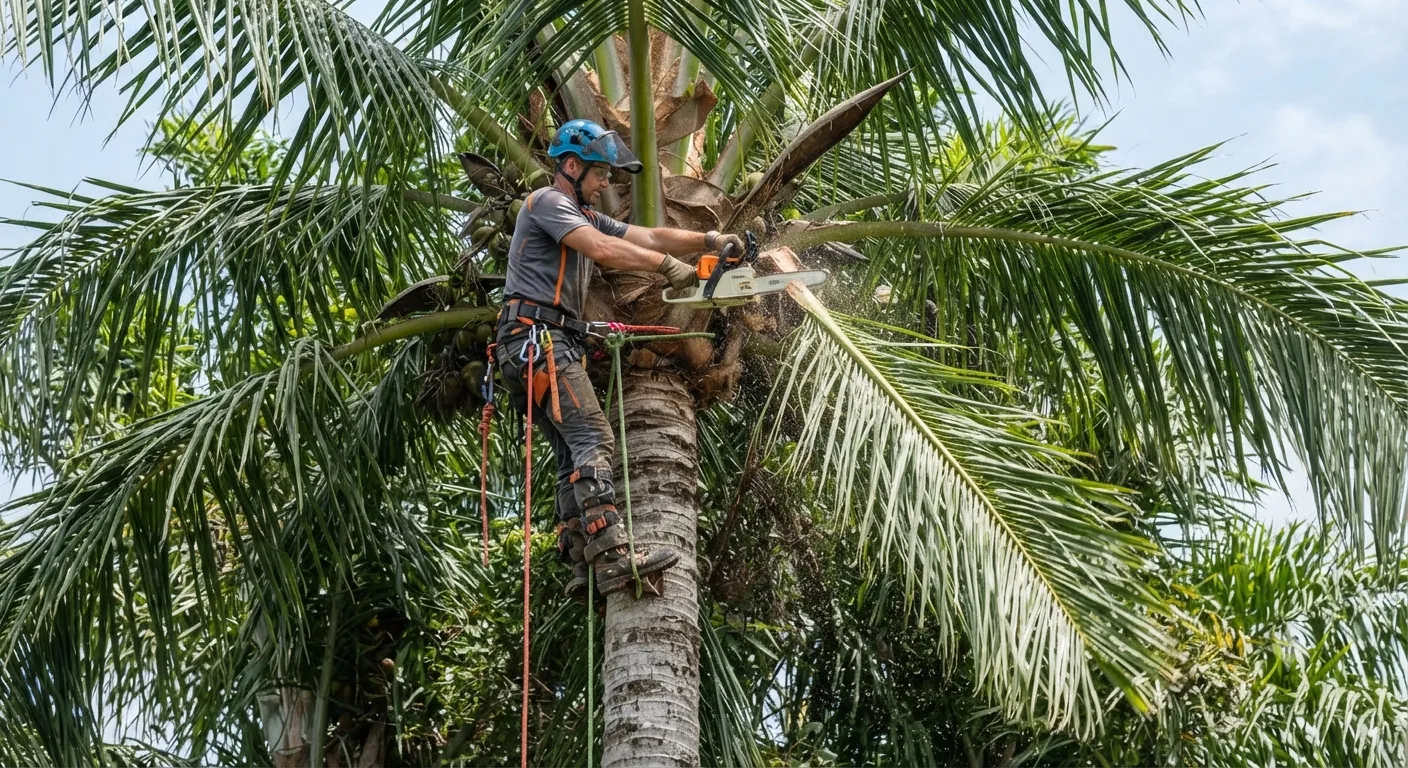
Two palms of identical height in the same street can be priced eight times apart, and the reason is what is growing on the fronds. An Alexandra palm is smooth, light and quick. A Canary Island date palm is a trunk up to a metre and a half across carrying dozens of fronds armed with long spines at the base, and every one of those has to be cut off by hand before the trunk comes down. So the first useful thing to do is identify what you own. The second is to send the job to arborists working in your postcode, because palm work is quoted on sight and the species is the first thing they will look at.
What does palm tree removal cost?
Between roughly $150 and $2,500 per palm. Before the numbers, a caution about where Australian palm prices come from. Go Tree Quotes runs the most-cited palm cost guide in the country and disagrees with itself on the same page: the opening line puts the average at $240, a panel beside it says $285, and the section on cocos palms quotes $350 to $750 while its own species table for that species reads $250 to $350. We have priced this page off the species table, because species is the variable a crew actually quotes on.
| Palm | Typical removal (AUD) | Why it prices where it does |
|---|---|---|
| Alexandra palm Archontophoenix alexandrae | $150 - $300 | Slim, smooth trunk and light fronds. About the cheapest tree job an arborist will quote you. |
| Bangalow palm Archontophoenix cunninghamiana | $150 - $250 | Similar build to the Alexandra and priced alongside it. |
| Cocos palm Syagrus romanzoffiana | $250 - $350 | The one most often taken out of Australian gardens. Fronds up to five metres long make the mess disproportionate to the trunk. |
| Golden cane palm Dypsis lutescens | $200 - $720 per clump | Grows in clumps rather than singly, so it is quoted by the clump. Figures here assume three stems. |
| Cabbage palm Sabal palmetto | $500 - $900 | Slow, careful work around teeth on the frond bases. An older specimen with a smoothed trunk is cheaper. |
| Cotton palm Washingtonia filifera | $600 - $1,200 | Sharp spines the length of every frond stalk. Height is easy; the armour is not. |
| Foxtail palm Wodyetia bifurcata | $650 - $1,100 | Sap that corrodes gear, so saws come apart for cleaning afterwards. That time is in the quote. |
| Canary Island date palm Phoenix canariensis | $1,200 - $2,400 | The dearest palm in the country to remove. A trunk to 1.5 m across and up to fifty heavily spined fronds, each cut individually. |
If you do not know the species, height is the rough proxy: about $150 to $300 at five metres, $350 to $875 at eight, $520 to $1,290 at twelve, and $900 to $2,500 for anything approaching twenty. Note how much wider those bands get as the palm gets bigger. That spread is access, and it is the next section.
Why palms are priced differently to trees
Six things separate a palm quote from an ordinary tree quote, and not one of them is obvious from the footpath.
| What drives the price | How it works on a palm |
|---|---|
| Trunk girth, not height | Doubling a palm's height does not double the job. Doubling the width of its trunk very nearly does, because girth decides whether the trunk is cut in one and dropped or sectioned down in heavy rounds. |
| What is on the fronds | Spines and teeth turn a fast job into a slow, deliberate one. This is the whole reason a date palm and an Alexandra of the same height are an order of magnitude apart. |
| Where the waste goes | An ordinary tree becomes mulch the arborist can give away. Palm fronds and trunk do not mulch usefully, so they leave as waste and someone pays tip fees by the tonne. On a palm job that disposal is a serious fraction of the total. |
| Access to the base | A palm in an open front yard is felled and cut up where it stands. The same palm behind a pool fence is climbed and lowered in pieces, then carried by hand to the truck. That difference alone can be half the price. |
| How many you have | Palms are usually planted in threes and fives. The truck, the crew and the trip to the tip do not multiply with the palm count, so a row quotes far better per palm than a single. |
| The stump | Almost always quoted separately from the removal. Ask for it as a line item rather than assuming, and see the stump section below for why a palm stump is its own question. |
One thing that barely matters: your city. The same cost guide's capital-city table spans only about $220 to $261 top to bottom, and it prints the identical percentage column it uses on its tree removal guide. Treat city as noise and species as signal.
Does your council count a palm as a tree?
Here is the claim you will meet everywhere, including on that cost guide: palms can be removed without a permit because they are not native, so councils do not protect them. It is wrong often enough to be worth a paragraph. Whether you need approval turns on the definition of "tree" in the instrument covering your address, and Australian instruments answer that question four different ways.
| Where you are | Is a palm a "tree"? |
|---|---|
| City of Sydney, NSW | Yes, but the cocos palm is specifically let off. Syagrus romanzoffianum is named on the council's list of exempt species, removable without permission at any height, unless the palm is on the register of significant trees or the heritage trees list. |
| Bayside, VIC | No. The council states that palms, ferns and non-woody plants do not meet the definition of "tree" in its local law and need no local law permit. It adds a real caveat: planning permission may still be required where a planning permit attaches to the land, or where the plant is native to its VPO3 area. |
| South Australia | The question is never asked. A regulated tree is anything in the overlay with a single trunk of 1 metre circumference measured a metre above the ground, doubling to 2 metres for a significant tree. That is about 320 mm of trunk diameter, and the test says nothing about species or origin. |
| Queensland (neighbour disputes) | Expressly yes. Section 45 of the Neighbourhood Disputes (Dividing Fences and Trees) Act 2011 defines a tree as any plant resembling a tree in form and size, and gives "bamboo, banana plant, palm, cactus" as its examples. It also counts a bare trunk and a stump rooted in the land. |
So a mature cocos palm can be exempt by name in one council, outside the definition entirely in another, and squarely inside a dimensional test in a third state. If the palm is big enough that any of this could bite, check with your own council before a saw comes out of the truck. It is one phone call, and it is the only answer that applies to your particular block. And if the palm belongs to a neighbour, note the Queensland framing: the Queensland Government tells tree-keepers they are responsible for the whole tree, not just what is above ground.
Is yours a cocos palm?
Most Australian palm removals are the same plant. The cocos palm, Syagrus romanzoffiana, also sold as the queen palm, was planted across Australian gardens by the thousand and has been coming back out of them ever since. It is a single grey trunk, usually 20 to 40 centimetres thick, averaging around twelve metres but reaching twenty, carrying seven to twenty-five feathery fronds up to five metres long, with hanging clusters of orange fruit and dead leaves that stay on the plant.
The case against it is not aesthetic. NSW WeedWise records it as a weed in the North Coast region of New South Wales and in Queensland, spreading into eucalypt forest, rainforest and creek banks. Its fruit may be poisonous to dogs, though no specific toxin has been identified. And the harm to flying foxes is documented and grim: they are drawn to the fruit, their wings catch in the flower sheaths and leaves, and the seeds cause severe constipation that can kill younger animals or lodge behind their teeth so they cannot feed. Every fruiting palm keeps posting seed into bushland, which is why councils and land managers push their removal.
One practical instruction worth carrying out to the letter: after the trunk comes down, clear the fallen fruit from the area, or you will be pulling seedlings out of that garden bed for the next few years.
Palm tree pruning: what to cut and what never to cut
Plenty of people searching for palm removal want something less drastic. Pruning palm trees is its own job and a much cheaper one, and the scope of it is narrower than on any other plant in the garden.
What a palm genuinely needs is its spent fronds taken off, along with the flower and fruit stalks, which on a cocos is the difference between a tidy palm and a seed factory over your roof. That is close to the whole list. There is no crown thinning on a palm and no reduction pruning, because every frond a palm will ever have comes from the single growing crown at the top of the trunk. The clearest proof of that sits in the weed-control advice: NSW WeedWise's method for killing a cocos palm outright is to cut the trunk anywhere below the lowest leaf. One cut in the wrong place is not a pruning error on a palm; it is the removal method.
The corollary is that over-pruning is not recoverable. Stripping a palm back to a fistful of upright fronds is a fashion, not a technique, and the palm cannot grow a replacement canopy from anywhere except the crown you just emptied. Take the dead ones and leave the green ones.
Palm tree stump removal
Palms make the stump question simpler in one way and harder in another.
The simple part: a palm stump will not come back. NSW WeedWise states that cocos trunks do not need to be treated with herbicides because they will not re-grow, which is the opposite of a cut gum or camphor laurel stump quietly sending up shoots for years. If your only worry is regrowth, you can leave it.
The harder part is that the trade does not agree on what pulling one out is worth. The same cost guide quoted above says palms are soft through and puts a 30 to 40 centimetre palm stump at about $50 each, then answers its own frequently asked question by calling a palm stump one of the most difficult types to remove because the roots go as deep as a metre. Elsewhere again it describes palms as having a shallow root system. All three statements sit on the one page, so treat any confident number you are quoted for a palm stump as a starting position. Get it priced as its own line item, and see stump removal and stump grinding for how that work is priced generally.
Choosing a qualified, insured arborist for palm work
Palm jobs attract cheap operators because the trunk looks like a pole. Three things are worth asking about, and the first one is specific to palms.
- Do they disinfect between palms? The City of Canterbury Bankstown has been managing Fusarium wilt in its Phoenix palms for close to fifteen years and is now removing dead ones. Its own explanation lists undisinfected pruning tools among the ways the fungus travels, alongside contaminated soil and seed. Council states plainly that testing shows Fusarium will kill a palm once it is infected, and the pathogen it leaves in the soil threatens replacements of the same species. Council lists it as affecting Phoenix, Washingtonia and Syagrus palms, which is the date, cotton and cocos palms in the table above. A crew that runs an unwashed saw down your street is a genuine risk to your palms, and disinfection of equipment is written into AS 4373-2007, the Australian pruning standard, as a clause of its own.
- Can they identify the plant, on paper? Species exemptions cut both ways. Where the City of Sydney exempts the cocos palm, it also makes the owner responsible for establishing that the plant really was on the exempt list, and it says identification should come from someone holding at least AQF Level 3 in arboriculture or horticulture. If you are relying on an exemption to skip a permit, the qualification behind the identification is the thing standing between you and a fine.
- What does the certificate of currency actually say? Arboriculture Australia sets $5 million of public liability as the floor for registration, with $2 million of professional indemnity added for its consulting grades. That is an entry requirement, not a market average, and particular authorities demand far more for particular tasks: Brisbane City Council wants $20 million behind an arborist reporting on vegetation it protects. Ask to see the document rather than the claim.
If the palm is dead, leaning, or dropping fronds onto something that matters, treat it as a removal rather than a maintenance job. For anything that is not a palm, tree removal and tree pruning cover how those are quoted, and arborist reports explains the document councils ask for when they want convincing.
Find palm tree removal near you
Palms cluster where the climate suits them, so the crews who work with them daily are concentrated too: Queensland's coast, Sydney's north and east, the Adelaide plains. Local experience shows up as a faster, cheaper quote, because someone who removes cocos palms every week is not guessing at the frond load. Choose a city, or search the directory by postcode.
Frequently asked questions
How much does palm tree removal cost in Australia?
Roughly $150 to $2,500, and the species matters more than the height. A slim Alexandra or bangalow comes out for $150 to $300. A cocos palm, the one most often removed from Australian yards, sits around $250 to $350. A mature Canary Island date palm, with a trunk that can reach a metre and a half across and fifty spined fronds to strip, runs $1,200 to $2,400. Get the species named on the quote.
Can you remove palm trees without council approval?
Sometimes, and it turns entirely on how your council defines the word tree. Bayside Council in Melbourne states that palms do not meet the definition of tree in its local law at all. The City of Sydney names the cocos palm on its list of exempt species. South Australia, by contrast, applies a purely dimensional test that never asks what species you have. Do not rely on the widely repeated claim that palms are unprotected because they are not native, because the tests that catch them do not mention nativeness.
Do palm tree stumps grow back?
No, and this is the one way a palm is easier than a hardwood. NSW WeedWise gives the control method for a cocos palm as cutting the trunk anywhere below the lowest leaf, and states plainly that the trunks do not need to be treated with herbicides as they will not re-grow. A cut gum stump can coppice for years. A cut palm is finished. You may still want the stump ground out to reclaim the ground, but you are not fighting regrowth.
What does palm tree pruning involve?
Taking off spent fronds and the flower and fruit stalks, and nothing else. All of a palm's growth comes from the single crown at the top of the trunk, which is why NSW WeedWise can list cutting the trunk below the lowest leaf as a method of killing one outright. There is no crown thinning or reduction pruning on a palm, and stripping it back to a handful of upright fronds is a haircut it cannot recover from.
Why are so many cocos palms being removed in Australia?
Because the species turned out to be a problem after everyone planted it. NSW WeedWise records the cocos palm as a weed in the North Coast region of New South Wales and in Queensland, notes that its fruit may be poisonous to dogs, and documents that the palms have caused injuries and death to flying foxes, whose wings catch in the flower sheaths and whose young choke on the seeds. Every palm keeps setting fruit that birds and bats carry into bushland.
Is it cheaper to remove several palms at once?
Considerably, and more than most people expect. A large share of what you pay covers getting a crew, a truck and a chipper to your address and disposing of the waste afterwards, none of which doubles when the second palm does. If you have a row of them, quote the row rather than one at a time, and ask for the price both with and without waste removal so you can see what the tip fees are actually costing you.
Every dollar figure above is AUD, checked during August 2026 against published Australian palm rates. Read them as something to hold a quote up against, not as an offer. Every council, state and standards reference cited here was read first-hand on that authority's own website the same week, and any of them can be amended without warning, so treat your own council as the last word on your block. We list arborists and pass enquiries to them. We do not price, book or carry out any of the work described above.
Ready to get that palm out?
Name the species and the access, and let arborists near you price it properly. No account, no fee, no obligation.
Find a Palm Tree Removal Arborist Near You