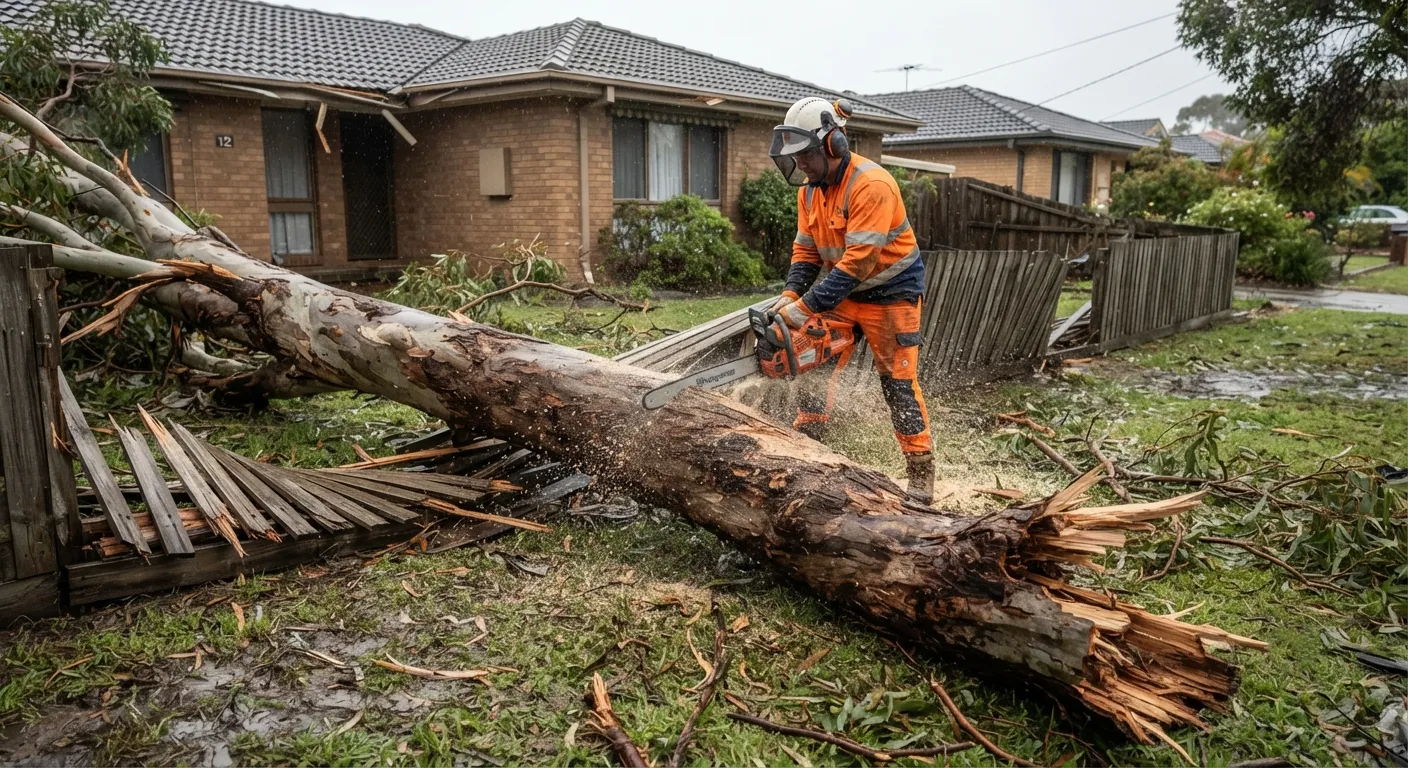
Emergency tree removal is what you buy when a tree has failed, or is about to, and Tuesday is too late. Same climbing and cutting as any removal, done at night or in the rain by a crew that dropped what it was doing, so the premium is for the hour rather than the timber. One thing first: the emergency services and the arborist do different jobs, in that order, and most people reverse them or skip one. Once the site is safe, get the details in front of arborists covering your suburb with a photo attached, because a picture prices faster than any description down the phone.
Who to ring first, and what each one will actually do
The State Emergency Service takes storm-damage calls on 132 500. What it does once it arrives is narrower than most people expect, and the three biggest states draw the line in three different places.
| State service | What it says it will come out for | Where it stops |
|---|---|---|
| NSW SES | A fallen tree blocking access to a front door, driveway or road; a tree threatening to fall on your property or driveway; a damaged or leaking roof; damage you cannot fix yourself. | Volunteers undertake temporary emergency measures to make the situation safe. Permanent repairs and remaining debris go to your insurer or a private contractor. |
| VIC SES | A tree down that has caused structural damage to your home or vehicle; a tree or large branch stopping you entering or leaving; significant roof damage; flooding. | Explicitly sends you elsewhere for minor damage, debris removal and cutting down trees that are still standing. |
| SES Queensland | Trees down causing structural damage or blocking property access, where the property is an occupied primary residence. | Publishes tree lopping and removal on its list of assistance it does not provide, along with powerlines down and debris clean-up. |
Read the last column and the pattern is the point. New South Wales will come to a tree that has not fallen yet. Victoria will not, and points you at a professional tradesperson in the same breath. Queensland names tree removal among the things it does not do at all, confines itself to occupied primary residences, and separately rules out fences, sheds and yards, which between them cover a fair share of what a falling tree actually lands on. None of that is unhelpfulness. They make things safe under pressure; the trunk on your lawn at 6am belongs to somebody with a chipper.
One piece of advice on trade cost guides needs correcting, because it sounds sensible: ring the SES, let them clear the hazard, and you have bought time for a cheaper quote in daylight. Half right. The rest is not what any of the three say they do, and in Queensland it is the reverse of its own published list.
What actually counts as an emergency?
The after-hours premium is real, so be honest about which tier you are in. Only the first is a phone call in the dark.
- Now. A tree or limb on a roof, a car, a shared fence, or across your only way out. A split trunk propped on something never built to hold it. Anything touching wires.
- This week. Movement at the base, fresh cracks in the soil, a hung-up limb, new lean after heavy rain. No reason to ring at 11pm, every reason not to wait for the next front. Take the first daylight slot at standard rates.
- Book it in. Leaf litter, small deadwood, a branch on the lawn. Ordinary pruning or removal, and paying a premium for it is money set on fire.
Fallen tree removal, and why it costs less than you fear
A tree already on the ground is, counterintuitively, among the simpler jobs an arborist gets. Nothing to climb, nothing lowered in sections past a gutter, and gravity has done the dangerous part. What remains is cutting and shifting weight. The trade's cost guide prices fallen tree removal from $1,600 to $3,000 at 10 metres, rising to a $2,000 to $5,000 band by 15 to 20 metres, with access driving the spread.
The complication is rarely the tree. It is what the tree hit, and what it is now holding up. A trunk across a fence line is under load and will roll or spring if cut out of sequence; one on a roof is doing structural work for the building until somebody plans how to take the weight off. Where it fell over a boundary, whose tree it was is a daylight conversation between two insurers.
A tree in the powerlines is not an arborist job
Here the answer is legal rather than practical, and it is flat. Asked whether a property owner may trim trees near its network, Ausgrid answers "No". Its rule inside three metres of a powerline is that the work "must only be done by workers accredited", the accreditation in question being the SafeWork code of practice covering work near overhead powerlines. That excludes you, the neighbour with the pole saw, and any crew without the ticket. Other distributors set their own clearances under their own state's rules, so ring the network operator where you live. Until they arrive, keeping people back is your job: NSW SES asks the public to stay clear of trees and powerlines brought down in a storm, and downed lines sit on Queensland's not-attending list too.
What drives the price of an emergency call-out
No Australian government body publishes emergency tree pricing, so treat any national rate with suspicion. What the trade says plainly is that emergency call-outs attract a substantial premium, because the work happens outside business hours in hazardous weather and a crew has to be mobilised fast. Here is what moves the number once someone is on site.
| What drives the price | Why it matters at 10pm |
|---|---|
| The hour you ring | The premium is for pulling a crew together after hours, not for the cutting. The same tree at 9am Monday is a different quote. |
| Standing or already down | Down is cheaper. A damaged tree still upright has to be climbed or reached, and a compromised one is slow, careful work: the trade adds 20 to 40 per cent for dead or structurally compromised trees before any emergency loading. |
| What it is resting on | A trunk on grass is cutting. A trunk on a roof, a car, a pool fence or a boundary is a rigging problem, and the plan has to protect what is underneath. |
| Access for the truck | Whether a chipper and tipper can get near the work decides how much is dragged by hand. Rear yards, narrow side gates and steep blocks all add hours. |
| Whether a machine is needed | A cherry picker or crane turns a two-person job into a scheduled one, and in the middle of a storm event getting hold of either can be the harder problem. |
| Make-safe now, remove later | Often the cheapest real option. Pay for the hazard to be dealt with tonight and book the clean-up, the stump and the timber at ordinary rates. |
| Where the debris goes | Green waste leaving on a truck is a disposal charge on top. Chip left on site is not. See mulching for how that part is normally handled. |
Hiring in a hurry without getting stung
Storms are when people hire badly, and a regulator has already written the checklist. SafeWork NSW publishes a fact sheet on hiring tree work contractors that opens by calling this a dangerous job and telling homeowners to hire a professional. State guidance rather than national law, but the checks travel.
- Qualifications, and the bottom rung is lower than you think. SafeWork describes a professional outfit as one with at least one person holding a Certificate II in Arboriculture for ground-level work and a Certificate III to supervise climbing. For a written assessment it points you to an arborist holding a Diploma of Arboriculture.
- Cover you can verify, not cover you were told about. The fact sheet asks for workers compensation plus public liability, which it explains as the protection for your property and your neighbour's if damage or injury happens during the work. Then the line nearly everyone skips: test it by asking for a certificate of currency, or ring the issuing insurer. Arboriculture Australia will not register a practising arborist who cannot produce liability cover of at least $5 million, so a registered member has cleared that bar already.
- A method, said out loud. They should be able to describe how the work will be done safely. On a loaded trunk the sequence of cuts is the whole job.
- Something in writing first. SafeWork's minimum is an ABN, contact details, the work described and the costs. Two lines in a text at midnight is fine; a number shouted over a chainsaw is not.
Then the hazard specific to a storm week: travelling conmen, in the regulator's phrase, deceptive people pretending to be legitimate tradespeople. The signs it lists are what turns up after wind: an unannounced knock with a today-only deal, an offer to drive you to the bank for payment, and vanishing with the work unfinished. Report them to NSW Fair Trading on 13 32 30; safety concerns about a tree contractor go to SafeWork on 13 10 50.
Will your insurer pay for it?
Probably some of it, and nothing gets you past reading your own policy. No government consumer page answers "does home insurance cover tree removal" head-on, which is worth knowing given how confidently the internet does. Moneysmart confirms the general shape only: most home and contents policies cover storms, taking in lightning, cyclones, strong winds, rainwater, hail and snow, and if you are unsure what you hold, read the product disclosure statement. Carting the tree away and repairing what it struck are separate questions, and the PDS settles the first. Photograph the scene before anything is cut, have make-safe and removal itemised separately, and call the insurer before authorising non-urgent work.
Emergency tree removal near you
Round-the-clock arborist coverage is a big-city thing, so this list is deliberately short. Anywhere else, try the largest tree business in the district before the nearest one, and ask what its after-hours arrangement amounts to.
Frequently asked questions
Will the SES remove a fallen tree from my property?
No. Crews come out to make a situation safe; the tree stays yours. Queensland lists tree lopping and removal among the assistance it does not provide. Victoria asks you to call a professional tradesperson for debris and for standing trees. New South Wales calls its work temporary emergency measures. Ring them when the triggers are met, then book an arborist for the rest.
How much does emergency tree removal cost in Australia?
Nobody publishes a national figure, so distrust any page quoting one. The trade says only that emergency call-outs attract a substantial premium, for the after-hours mobilisation rather than the cutting. A tree already blown over sits at the cheaper end of the same night, because nothing has to be climbed: the trade guide starts a fallen 10 metre tree at $1,600. Damaged but still upright costs more.
Does home insurance cover emergency tree removal?
That is a question for your policy, and no government consumer page answers it directly. Moneysmart confirms only the general position, that most home and contents cover extends to storms. Whether carting the tree away is covered, as against repairing what it hit, is settled by the product disclosure statement rather than by any rule of thumb. Photograph everything before the chainsaws start.
Someone knocked on my door offering to clear the tree. Should I use them?
Be careful. SafeWork NSW warns about travelling conmen who arrive unannounced pretending to be legitimate tradespeople, and names the signs: today-only deals, an offer to drive you to the bank for payment, and disappearing mid-job. Ask for a quote showing an ABN, ask for a certificate of currency, and pay a business you could find again next month.
Is a leaning tree an emergency?
It depends which state you are in, which is the honest answer rather than a dodge. In New South Wales a tree merely threatening to fall is on the SES call-out list. Victoria does not carry that trigger. Queensland asks instead whether access is blocked or further damage threatened. If yours fails your state's test it is still urgent arboriculture: a tree that has moved in the ground has already failed, and it wants looking at within days.
Dollar figures here are Australian, were read in August 2026 off the trade cost guide publishing them, and represent one operator's estimates rather than a market rate. Emergency work is priced on the night, by whoever attends. Call-out criteria belong to each state emergency service and are revised without notice, so treat the agency page as the authority and this one as a map to it. This site lists arborists; it does not do the work.
Need someone out tonight?
Make the site safe, take a photo, then put the job in front of crews working your postcode.
Find an Emergency Tree Removal Arborist Near You