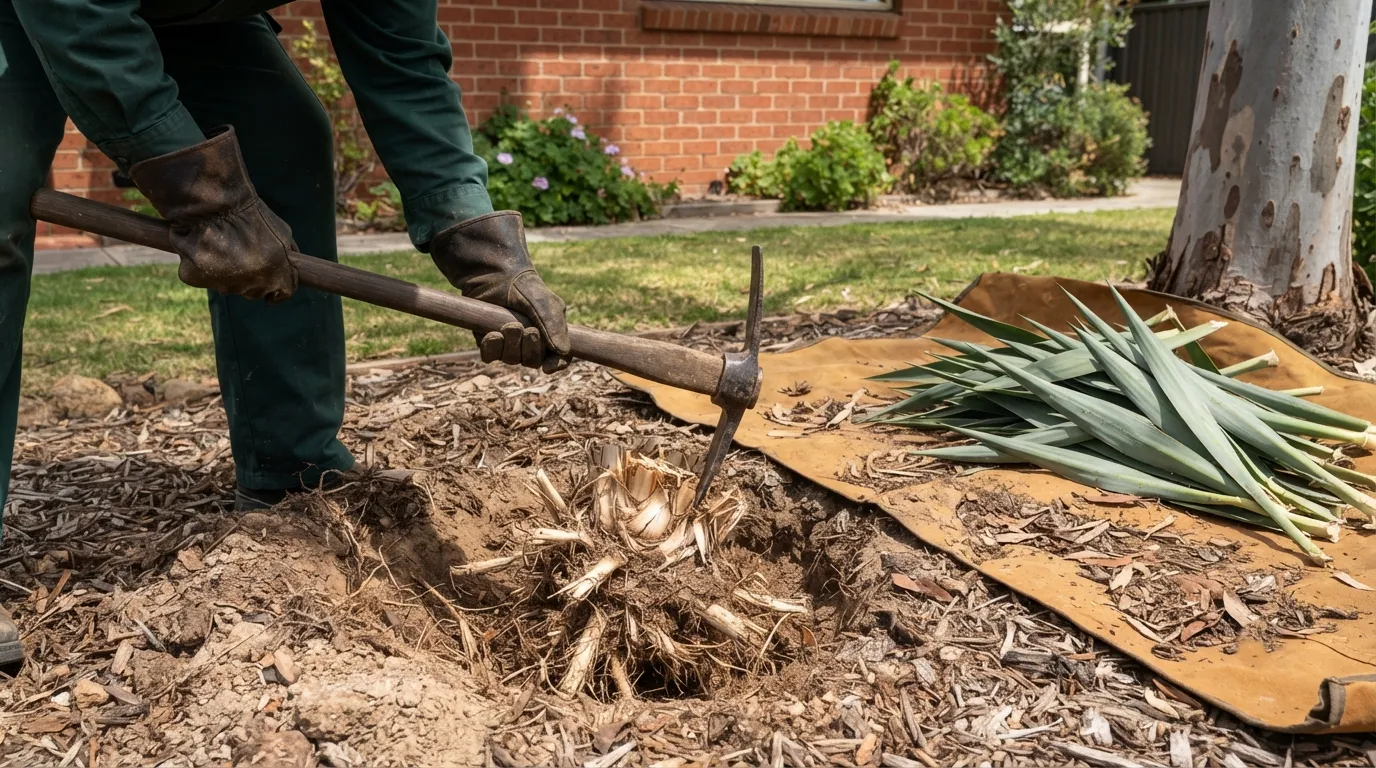
There is a class of garden plant that ignores being cut down. Bamboo runs underground and comes up somewhere new. Prickly pear grows a fresh plant from a segment that has simply fallen on the ground. Camphor laurel is planted for you by birds, which is why it appears along fence lines. Yucca and agave are not finished when the leaves are gone. Getting rid of any of them is not really a cutting job, which is why a tidy-up that looked like a Saturday becomes three visits and a tip run that costs more than the plant did. If yours has beaten you already, tell crews in your area what you are dealing with and have the whole thing quoted, roots and rubbish included.
How do you get rid of yucca plants for good?
Not by cutting it off at the base, which is the thing most people try first. Brisbane City Council runs a public weed identification tool that lists the accepted control methods species by species, and for Yucca aloifolia it gives two: the cut stump method, where the cut surface is treated, and foliar spray. Neither of them is simply felling it.
NSW WeedWise states the principle that sits behind that for pest plants generally: "successful weed control relies on follow up after the initial efforts. This means looking for and killing regrowth or new plants", and that a combination of methods usually works better than one. So the two realistic endings are lifting the base and its root system out of the ground, by hand on a small plant and with a machine on an old one, or cutting and treating and coming back for what returns. A quote written as a single visit has been written for the wrong plant.
Agave is the same argument at a larger scale. Brisbane's entry for Agave americana, the century plant, describes leaves one to two metres long whose margins carry "numerous prickly teeth" and which "end in a dark-brown spine (2-3 cm long)". Mature clumps reach two to four metres across and throw a flowering stem the council puts at "5-12 m tall". That is tall enough to need the access and rigging thinking of a small tree, on a base that has to be dug, guarded by several hundred spikes.
Which plants count as problem plants?
There is no official list with that name on it. The jobs quoted this way share three features: the plant resists ordinary cutting, it spreads by something other than being planted, and its material is awkward to get rid of. The regulars are yucca, agave, bamboo, prickly pear and other opuntioid cacti, cocos palm, camphor laurel, privet and cordyline.
Whether any of them is legally a tree is a live question, and it changes what applies. Section 45 of Queensland's Neighbourhood Disputes Act 2011 stretches the word past woody plants to cover anything of similar form and size, and the four examples the Act supplies for that limb are "bamboo, banana plant, palm, cactus". So a Queensland neighbour arguing about your bamboo is arguing under tree law. Cocos palm has enough of its own rules to sit on a separate page.
Two carry national weight. Weeds Australia lists 32 Weeds of National Significance agreed by Australian governments, and the opuntioid cacti, the prickly pears and their relatives, appear on it as one grouped entry. Camphor laurel is regional rather than national, but heavy where it lands: NSW WeedWise puts the infestation in the Tweed, Brunswick and Richmond river catchments at around 91,000 hectares.
Bamboo removal: dig it out, or cut and treat?
It depends which bamboo you have, and you can tell them apart yourself. NSW WeedWise's profile of clumping bamboo describes short rhizomes held in a dense clump, and says of it plainly that it is "not as invasive as rhizomatous bamboo". Running bamboo is the other genus, Phyllostachys, whose rhizomes travel away from the clump underground. The difference is visible in the canes: running types carry a groove on the side of the stem where each leaf grows from, alternating up the cane. If new canes are appearing metres from the parent stand, or through a fence, you have the running kind and a bigger job.
Either way, cutting is not removal. The same page states that plants "can be controlled by digging out the base of the plant and removing all the rhizomes and roots", that "excavators can remove large infestations", and that "permits may be required if the bamboo is close to waterways or native vegetation". That last line is easy to skim past and matters on a creek-side block: the machine that solves your bamboo may be the reason you need an approval you did not know about.
Cutting alone works eventually, in the way starving something works, and WeedWise notes that "continually removing the shoots by mowing or cutting will eventually kill plants". That is a regime measured in seasons. Where a cut stump is treated chemically the timing is unforgiving, the guidance being to treat within 15 seconds of the cut and to spray regrowth before it reaches 50cm. Those numbers are why the work is priced with return visits in it.
Does taking out a weed still need council approval?
Sometimes, and this is where most people guess wrong. Weed status and tree protection are decided by two bodies of law that do not consult each other, and both can apply to the same plant on the same afternoon.
The City of Sydney publishes the clearest worked example. Its list of exempt tree species names the plants that "can be removed without our permission" unless the specimen happens to sit on the council's significant or heritage tree registers, and among them, at any size, are "Bamboo sp (all species and cultivars)" and "Ligustrum sp (privet)". A second, separate list applies only "if the tree is less than 10m tall", and the first name on it is "Cinnamomum camphora (camphor laurel)".
Read the two together and the catch appears. NSW WeedWise records that camphor laurel "grows up to 20 m in height", on "a short, stout bole or trunk up to 1.5 m in diameter". The exemption covers the half of the range nobody needs help with. The mature specimen shading your back fence, the one you would actually pay to remove, is over the line and back inside the permit system, weed or not.
The same council then puts the risk where it hurts: "property owners are responsible for ensuring the tree species was listed as being exempt". It recommends that "identification should be obtained by a qualified arborist or horticulturalist with a minimum level 3 in arboriculture or horticulture (AQF)", and adds advice worth taking on any of these jobs: "where possible, we suggest you keep photo evidence in case we make contact and you need to show the works didn't require a permit". Photograph the plant before it comes out. It costs nothing and it is the only evidence that will exist afterwards.
None of this transfers between councils. Sydney's exemption list is Sydney's. Find your area and check the position where you live before a saw is started.
The regulated step is usually the disposal, not the cut
This is the part of the job homeowners do not price and contractors do. Nothing stops most people cutting one of these plants down. What is regulated, and what carries the real risk of spreading it further, is where the material goes afterwards.
Brisbane City Council's weed tool prints a declaration status against each species, and the split is instructive. Yucca and agave both come back "NIL", flagged for information only. Prickly pear and camphor laurel come back as "Category 3 Restricted Matter (Biosecurity Act 2014)", and the council spells out what that means: "must not be distributed or disposed. This means it must not be released into the environment unless the distribution or disposal is authorised in a regulation or under a permit". That is not a rule about removing the plant. It is a rule about moving it.
New South Wales arrives at the same place by a different road. Every pest plant there sits under the general biosecurity duty, which WeedWise states as a duty on "any person who deals with any plant, who knows (or ought to know) of any biosecurity risk" to see that the risk "is prevented, eliminated or minimised, so far as is reasonably practicable". For camphor laurel in the Hunter the regional measure goes further, recommending that "a person should not buy, sell, move, carry or release the plant into the environment". Queensland frames its version as a general biosecurity obligation, which Business Queensland describes as everyone being obliged to take reasonable and practical measures to minimise the risks invasive plants pose.
The mechanism is not abstract, and two states name it. WeedWise records that bamboo "can be spread by people dumping garden rubbish containing rhizome fragments". Tasmania is blunter still about opuntioid cacti, which it declares under its Biosecurity Act 2019 and whose "importation, sale and distribution" it prohibits: "most spread in Australia has been by people, either as garden plants and hedges, or through dumping in rubbish tips or bushland". A trailer-load taken to the wrong place, or tipped over a back fence onto a reserve, is how the next infestation starts.
Then there is the bin, which is where the cost lands. South Gippsland Shire in Victoria publishes its gate fees from 1 July 2026 and excludes from its greenwaste rate any stump, any branch thicker than 300mm, coated timber, a list of named weeds, and "species that physically cannot be mulched (such as bamboo, palm fronds, Cordylines, Yuccas and related species)". Everything on that list is charged at the general waste rate instead. The same trailer, the same trip, a different rate:
| Same load, one council's gate | As greenwaste | As general waste |
|---|---|---|
| Car boot or station wagon | $9.00 | $49.50 |
| Ute, level load | $15.00 | $99.50 |
| Ute, heaped | $27.00 | $175.00 |
| Trailer to 6x4, level | $15.00 | $99.50 |
| Trailer to 6x4, heaped | $27.00 | $175.00 |
| Trailer to 6x4, caged | $53.00 | $264.00 |
| Trailer over 6x4, heaped | $35.00 | $255.00 |
| Trailer over 6x4, caged | $71.50 | $384.00 |
Those are one Victorian council's rates, reset each 1 July, so read them as an illustration of the gap rather than a price for your suburb. The gap is the point: six to seven times on identical volume, decided entirely by what is in the trailer. Note also that NSW WeedWise says bamboo "stems and leaves can be mulched" while South Gippsland puts bamboo among the species that physically cannot be. Both are current and official and they disagree, which is reason enough to make disposal an explicit line in the quote. Where material can be chipped and stays on site, mulching takes the tip out of the equation.
What problem plant removal costs in Australia
No Australian cost guide prices this work. The commercial guides that break tree removal and pruning down to the cut carry no page for bamboo, yucca or agave, and there is no government or industry schedule either. That absence matters: any confident national average you are shown for bamboo removal has been produced rather than measured.
What can be priced honestly is the parts, and they are unusual for this trade. Most tree jobs turn on height and what is underneath. These turn on what is below ground and what happens afterwards.
| What moves the price | Why it matters |
|---|---|
| Root mass, not plant height | A one-metre yucca can sit on a crown that needs a machine, while a four-metre bamboo cane pulls out by hand. What has to leave the ground sets the day, and it is not visible from the street. |
| Whether a machine can reach | An excavator through a side gate is the difference between a morning and two days of mattock work. Rear courtyards with no vehicle access are the expensive ones. |
| How many visits it needs | Cut-and-treat species are quoted with follow-ups because the regrowth is expected. A single-visit price on a running bamboo is a price for cutting it, not removing it. |
| Disposal class of the material | Green waste rates or general waste rates, and for restricted species a route that satisfies the rules on moving it. On the schedule above that difference runs six to seven times. |
| Volume, which is deceptive | Agave and yucca leaves are fleshy and heavy for their bulk. Bamboo is the reverse, all volume and no weight, and fills a trailer several times over on a small stand. |
| Spines, and what they do to handling | Agave's toothed margins and spined leaf tips, and the barbed bristles on a prickly pear fruit, slow the work and dictate what the crew wears. Handling time is real time. |
| Whether it is actually a tree job | A mature camphor laurel is a full-sized removal with rigging and traffic management, and is priced like one rather than like a weed. |
That last row catches people out on budget. A camphor laurel over 10 metres is quoted the way any tree of that size is quoted, so the relevant reading is the tree removal cost guide and the tree removal page rather than anything written about weeds. If the stump is staying in the ground after the plant goes, that is a separate job again.
Why they come back, and what actually stops them
Yucca, agave and bamboo are covered above. Two more survival strategies are worth knowing before you take a quote, because each one changes what the job has to defeat.
- Prickly pear regrows from a dropped segment. For opuntioid cacti, Tasmania's environment department states that "vegetative spread is the most common form of dispersal, occurring year round when stem fragments, immature fruit or flowers detach and make ground contact", that all segments and fruit "should be removed from an area as they are capable of re-growing, even under very harsh conditions", and that follow-up is essential for exactly that reason. On these plants the clean-up is the job.
- Camphor laurel coppices and seeds. WeedWise's control notes cover spraying "seedlings and coppice shoots", so the stump shoots and the seed bank runs on, some of it viable for three years. Birds have already planted the next ones, which is why WeedWise records that camphor laurel trees "readily establish along fencelines and under powerlines".
One exception saves money. A palm does none of this: cut the trunk and it will not shoot again, so if your problem plant is a cocos rather than a yucca the job really is finished when the trunk is down. The palm removal page covers it.
Where herbicide is part of the plan, the label is the law: registered products, rates and situations are set by the label and by permit. A crew doing this properly will tell you which product, at what rate, and when they are coming back.
How to choose someone for a problem plant job
The failure mode here is not a dangerous cut. It is a plant wrongly named, half-removed and dumped where it can start again, and all three are avoidable at the quoting stage.
Start with the name of the plant, because everything downstream depends on it. The free option first: NSW WeedWise closes every profile by directing readers to "contact your local council weeds officer" for "technical advice and assistance with identification", and most councils run the same role. If you want it from the contractor, borrow the City of Sydney benchmark and ask for a qualified arborist or horticulturalist holding at least AQF level 3.
Then ask, and listen for whether the answers are specific:
- What is it, and does it have a status here? A confident species name, and whether it is declared, restricted or neither in your state.
- Is this a dig-out or a cut-and-treat, and how many visits? If the answer is one visit on a running bamboo or an established yucca, ask what happens when it shoots.
- Where does the material go, and at what rate? Green waste, general waste, or a route that satisfies restricted-matter rules. This belongs on the quote, not in the assumptions.
- Are you insured for this, and can I see it in date? Public liability is the cover that matters when a machine is working near a fence, a drain or a boundary, and a certificate has an expiry on it worth reading.
Get it in writing with the disposal and the follow-ups named. On this work, two prices that look far apart are usually two different jobs.
Problem plant removal near you
Which species are a problem, and what your council says about taking one out, is local. Start with your area.
Frequently asked questions
Can I just cut a yucca off at the base?
You can, and that is rarely the end of it. Brisbane City Council's weed tool lists the accepted control methods for Yucca aloifolia and gives two, the cut stump method and foliar spray, neither of which is simply felling the plant. NSW WeedWise puts the general principle for pest plants this way: successful weed control relies on follow up after the initial efforts, which means looking for and killing regrowth or new plants. So the realistic options are lifting the base and its roots out of the ground, or cutting and treating the surface and returning for whatever comes back.
Is bamboo a declared weed in Australia?
Not as a blanket rule, and you will see it asserted online in the language of a weed classification system New South Wales no longer uses. NSW WeedWise profiles clumping bamboo under the general biosecurity duty that covers every pest plant in the state, rather than under a specific declaration. Brisbane City Council records no declaration at all against yucca or agave, marking them for information only, while prickly pear and camphor laurel are listed as Category 3 restricted matter. It depends on the plant and the state, so check your own council or state agency.
Do I need council approval to take out a weed?
Sometimes, and being a weed is not what decides it. The City of Sydney lets bamboo and privet go at any size, and lets a camphor laurel go only while it is under 10 metres tall, which is well short of the 20 metres NSW WeedWise says the species reaches. Above that height the same weed is back inside the permit system. The council also puts the burden of getting the species right on the owner, and suggests keeping photo evidence in case it asks later.
Can I put yucca or bamboo in the green waste bin?
Often not. South Gippsland Shire in Victoria states that its greenwaste rates do not cover tree stumps, branches over 300mm, or species that physically cannot be mulched, naming bamboo, palm fronds, Cordylines and yuccas, with general waste charges applying instead. On that council's schedule a heaped six by four trailer is $27 as greenwaste and $175 as general waste. Restricted species carry a separate problem: Brisbane records that Category 3 restricted matter must not be distributed or disposed of into the environment without authorisation.
What does it cost to remove a large agave, yucca or bamboo stand?
There is no published Australian rate for this work. The commercial guides that price tree removal and pruning in detail carry no page for bamboo or yucca at all, so a confident national average has been produced rather than measured. What moves the price is the size of the root mass, whether a machine can reach it, how many follow-up visits the species needs, and the disposal class of the material. A camphor laurel is the exception, because it is a full-sized tree and gets priced as one.
Should I call an arborist, a gardener or the council?
Call the council's weeds officer first if you are unsure what the plant is. NSW WeedWise points readers to that officer for technical advice and help with identification, and it costs nothing. For the work itself, a single small yucca is garden-maintenance scale, while a bamboo stand needing an excavator, or a mature camphor laurel, is arborist work with machinery and a disposal chain behind it. The City of Sydney sets the identification bar at a qualified arborist or horticulturalist holding at least AQF level 3.
The disposal figures above are one Victorian council's published gate fees, effective 1 July 2026 and reset annually, quoted to show the difference between two waste streams rather than to price a job anywhere else. No cost guide, government schedule or industry body publishes rates for removing these species, and this page does not invent one. Weed declarations, restricted-matter categories and species exemption lists are set per state and per council, change without notice, and are quoted here from the pages named, on the dates they were read. Herbicide rates and permits are matters for the product label. This site lists businesses and nothing more: the plant in your yard, the method and the price sit between you and whoever you engage.
Get the roots and the rubbish quoted
Say what the plant is, how big it has got and where it sits, and let crews near you price the whole removal rather than the visible half.
Find a Problem Plant Removal Arborist Near You